






A dataset that has barely been touched for a year may still have considerable value. An intermediate file generated yesterday may already be expendable.
That distinction is becoming increasingly important as AI systems create larger and more complicated data estates. Training datasets, checkpoints, embeddings, and inference logs do not all retain value for the same length of time.
AI Data Does Not Have a Single Shelf Life
In practice, leading AI teams are already making very different retention decisions based on data type.
Airbnb offers a useful example. Its personalized-search architecture separates various kinds of historical behavior according to their continuing usefulness.
Significant events, such as bookings and reviews, can remain part of a guest’s long-term profile up to seven years. By contrast, listing views—the much more frequent and ephemeral signal—are drawn from only the previous 21 days. Both contribute to the same model, but their useful lifetimes are not the same.
Decide What Deserves to Stay
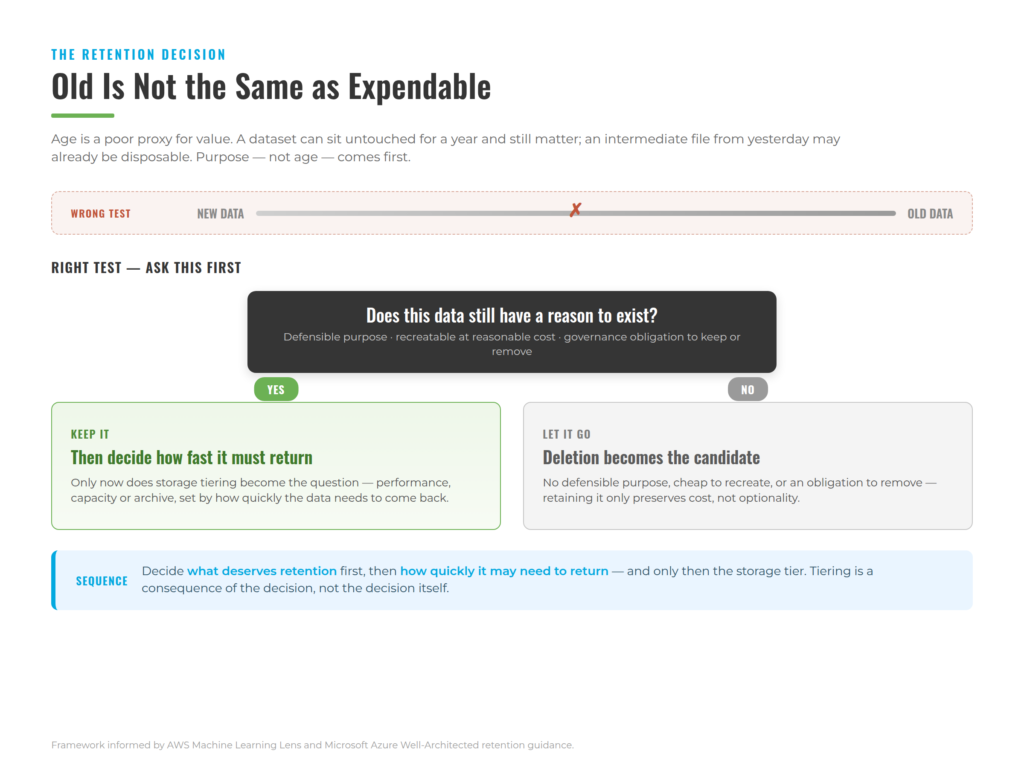
Age alone is a poor proxy for value. A dataset may be rarely accessed yet still matter for retraining, reproducibility, or recovery. Another may be recent but easy to recreate or no longer useful.
For infrastructure teams, retention therefore starts with purpose. Does the data still justify its footprint? Could it be recreated at a reasonable cost? Are there governance reasons to retain—or remove—it?
Only then does storage tiering become the question.
Why AI Data Can Remain Valuable Long After Its First Use
Historical data can regain operational value because model development rarely moves in a straight line.
At Pinterest, recommendation and advertising models train against tens of petabytes of engagement data accumulated over many months. When engineers want to test new features, simply beginning to collect those features isn’t always sufficient. Relying on forward collection can mean waiting three to six months for enough training history to accumulate. Pinterest therefore uses feature backfills to calculate the new features against historical data instead.
Why Model Lineage Matters
The same principle applies to reproducibility. LinkedIn’s MLOps infrastructure records model lineage because that information is necessary to reproduce results. Its metadata tracks training runs, artifacts and other steps involved in producing a model.
Model lineage is the record of the data, code, features, parameters, checkpoints and prior model versions that produced a particular model. Preserving that history can be essential for reproducibility, rollback, audit and understanding how a model reached a given result.
When Production History Becomes Useful Again
Production history can also acquire new value when something goes wrong. Logs and telemetry generated during normal operation may later help explain drift, unexpected model behavior or a failed deployment.
In a 2024 article, Uber recounted how its ML teams extracted training and inference data from historical application logs. The firm then fed the resulting information into subsequent training or evaluation workflows.
These are different use cases, but they point to the same conclusion. AI data can retain value because it makes future retraining, backfill, and reconstruction possible. That does not, however, mean everything deserves to stay.
“We Might Need It Someday” Is Not a Retention Policy
AWS makes the broader lifecycle principle explicit. Its current Machine Learning Lens warns against retaining training artifacts indefinitely. Instead it recommends removing unnecessary logs, models, experiment data and intermediate outputs while archiving material that genuinely needs to remain available.
This distinction matters. AI pipelines can generate far more than the authoritative data needed to recreate or understand a system. There may be numerous temporary transformations, intermediate checkpoints, and duplicate representations surrounding the underlying source data.
Microsoft’s Azure Well-Architected guidance addresses this tradeoff directly. After model training, if a large dataset has changed relatively little, retaining it can avoid the work of preprocessing the full dataset again.
A Framework for What to Keep, Tier, Archive or Delete
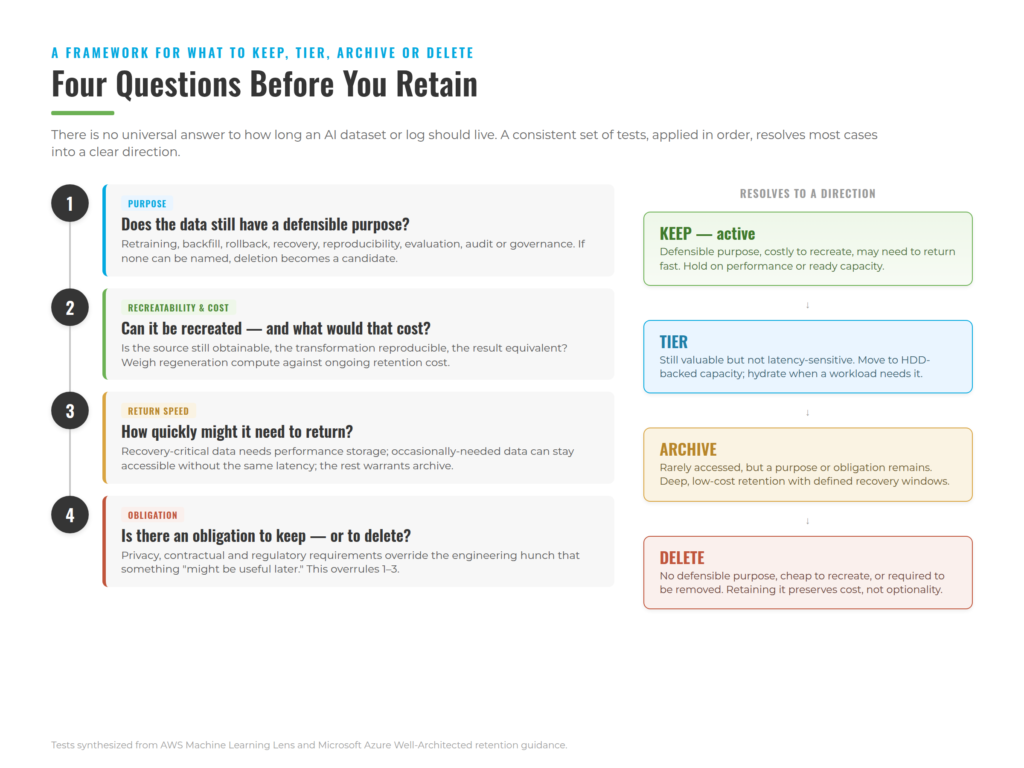
There is unlikely to be a universal answer to how long an AI dataset or log should be retained. But applying a consistent set of tests can help.
The first question is whether the data still has a defensible purpose. That might be retraining, feature backfill, rollback, disaster recovery, reproducibility, evaluation, debugging, audit, governance or another credible form of future reuse. If no continuing purpose can be identified, deletion becomes a candidate.
The second question is whether the data can be recreated, and what that recreation would cost.
- Can the original source still be obtained?
- Can the transformation be reproduced?
- How much compute would regeneration consume?
- Would the recreated artifact actually be equivalent?
- Would deletion eliminate information required to explain how an earlier model was produced?
The third question is how quickly retained data might need to return to active use. A current training dataset or recovery-critical checkpoint may need performance storage. A historical training dataset needed occasionally for retraining could remain readily accessible without requiring the same latency. Other data may warrant deeper archive treatment.
The fourth question is whether there is an obligation to retain—or to delete. Microsoft recommends explicit policies for removing personal data used in training and for eliminating data that is no longer used. More broadly, the engineering argument that something “might be useful later” cannot override privacy, contractual or regulatory requirements.
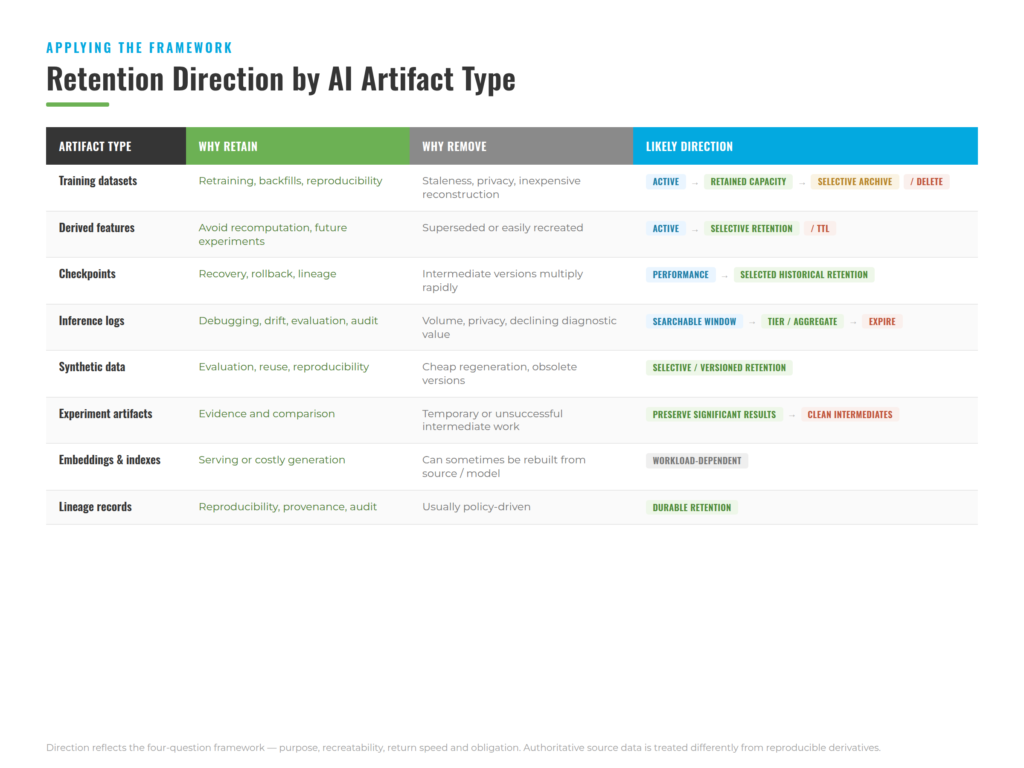
Checkpoints are saved snapshots of a model’s training state that allow training to resume without starting over. Recent checkpoints can be critical for recovery, while selected historical versions may support rollback, evaluation or reproducibility; most intermediate checkpoints do not need to be kept indefinitely.
What Mature AI Retention Looks Like
AI makes retention difficult precisely because future value is uncertain. Historical datasets can support new models and features, while production history can help explain problems that have not happened yet. At the same time, AI pipelines generate intermediate files, obsolete models, redundant derivatives and temporary outputs whose value can disappear quickly.
A mature retention approach therefore starts by distinguishing what is authoritative from what is reproducible. Source datasets and records that underpin future training, audit or recovery should be treated differently from temporary transformations, caches and derivatives that can be regenerated.
Embeddings and vector indexes are often reproducible derivatives rather than authoritative source data. Retention depends on the cost and feasibility of regeneration, the need to reproduce historical system behavior, and whether an older version still has operational or audit value. Live indexes typically remain on performance storage; superseded versions may be tiered, selectively retained or rebuilt when needed.
From there, lifecycle decisions should be attached to the data itself. Teams should know who owns an artifact, why it exists, what produced it, whether it can be recreated and when its continuing value should be reviewed. Where the answer is already clear, expiration should be automated rather than left to manual cleanup. AWS, for example, recommends lifecycle policies, explicit expiration information and automated deletion of unnecessary ML artifacts.
The same principle applies to lineage. Organizations need enough history to explain consequential models and reproduce important results, but that does not require preserving every intermediate object indefinitely.
Finally, retention should be tested operationally. If historical data is being kept because it may need to become active again, can the organization still find it, understand what it represents and restore or hydrate it within the required timeframe?
Otherwise, retention preserves cost without necessarily preserving useful optionality.
Where HDD Fits in the Retention Lifecycle
The retention decision comes first. Once an organization has established that data still has operational, governance or future-reuse value, the next question is how much performance that data continues to require.
For data that must remain readily available but no longer needs flash-level latency or IOPS, HDD-backed object storage, data lakes and scale-out systems can provide a durable capacity layer. That is particularly relevant to historical training datasets, selected checkpoints, retained logs, evaluation data and other large artifacts that may spend long periods outside the active path but still need to be brought back into use.
Meta’s current AI storage architecture illustrates the model. Its faster memory and flash tiers sit closer to GPU workloads, while a global BLOB-storage fabric backed by HDDs acts as a durable source beneath them. Data can then be hydrated toward higher-performance infrastructure when training or another workload requires it.
Retention Economics Change with the Storage Layer
The economics matter too. Uber found that high-volume logging workloads were putting heavy pressure on SSD infrastructure and making longer retention increasingly expensive. By re-architecting its logging pipeline around more efficient compression and lower-cost storage, it was able to extend retention to 30 days while keeping that history available for uses including ML training and inference analysis.
HDD therefore does not make the case for retaining data. It changes the economics once that case has already been made. For infrastructure teams planning large AI data estates, that means capacity strategy increasingly depends on understanding not only how much data is being created, but which parts of it are likely to remain valuable after their performance requirements decline.
Plan Capacity Around the Data Worth Keeping
The useful distinction is not between new data and old data, but between data that still has a reason to exist and data that does not. AI complicates that decision because value can return: a dataset may sit largely untouched for months before becoming useful again for retraining, investigation or audit, while an intermediate artifact may become expendable almost immediately.
For infrastructure teams, the sequence matters. Decide first what deserves retention, then how quickly it may need to return, and only then determine the appropriate storage tier. That keeps premium storage focused on active workloads while allowing lower-cost capacity to support data whose value persists beyond its performance requirements.
High-capacity HDDs have an important role in that middle ground. They can make large-scale retention more economical, but they do not remove the need for lifecycle discipline. The strongest storage strategy starts with keeping the data that matters—and knowing when the rest can go.
Horizon helps data centers, systems integrators and enterprise teams source and qualify high-capacity HDDs for large-scale storage environments, including new and factory-recertified inventory.