





When it comes to hard drive reuse, the attention is almost always on sanitization. But firmware, the embedded software that governs the “how” of data storage devices, deserves careful consideration too. On secondary market drives, firmware is frequently outdated, and getting access to hard drive firmware updates can be a major barrier to reuse.
While a common issue on the secondary market, the procurement risk of outdated firmware is typically under-appreciated. But for systems integrators managing mixed-vendor storage environments, firmware can quickly become a central obstacle.
The Hunt for Firmware Updates
In a Circular Drive Initiative (CDI) panel discussion held in April 2026, CDI president Jonmichael Hands made a strong claim. “I would say we have bought a tremendous amount of used drives and not a single one has ever had the latest firmware. Ever. Zero. 0%.” The ensuing panel discussion did much to clarify the issue.
Falling Through the Cracks
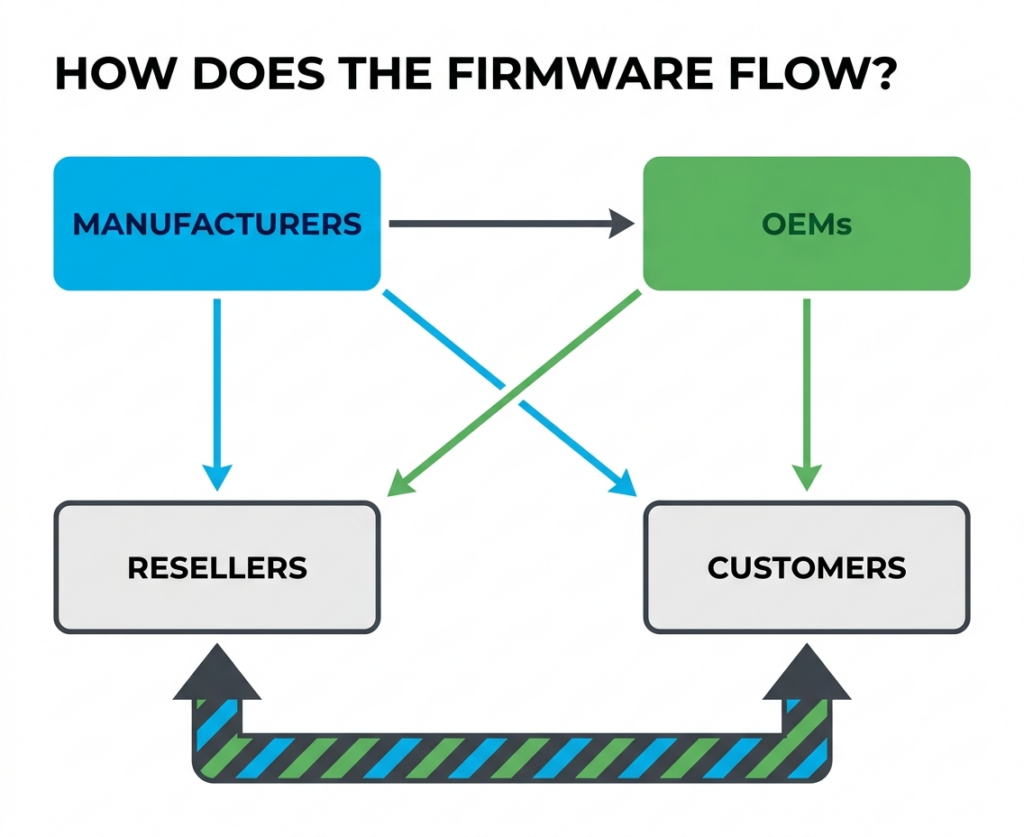
The reason is ultimately structural: as drives change hands, responsibility for hard drive firmware updates can fall through the cracks. For example, when an enterprise drive is sold by an OEM such as Dell or HP, it will typically arrive with firmware customized for that vendor’s environment. When these drives move on after a refresh, their firmware can present an unwanted tie between a new owner and an old supplier relationship.
Too often, neither the manufacturer nor the system vendor are willing or legally obligated to help update the firmware. Hands described the practical reality around firmware updates: “Getting these are extremely challenging…it’s really hard to get this stuff.”
Customer Reluctance
CDI panelist Jeff Harper of Smith & Associates pointed out an additional issue: even when updates are available, customers can be reluctant to implement them. Sometimes operators will even specifically ask for old firmware versions which they know are stable. And it’s not hard to see why: updating a single drive in a production array can introduce a firmware mismatch, potentially resulting in compatibility issues.
Jonmichael Hands concurred. “It’s ingrained in so many data center operators’ heads. ‘Nope, we have a stable version, don’t fix anything…[but] SSD firmware is not what it was 10 years ago. The reliability and update cycle is very, very different.’ ”
As both Hands and Harper note, operator concerns reflect an understandable caution surrounding compatibility. However, times have changed: SSD and HDD firmware quality has improved substantially, so there are real downsides to sticking with old firmware.
Supplier Reluctance
Harper also made it clear that supplier reticence is an issue. “For whatever reason, a lot of the quality engineers at the suppliers, they don’t feel comfortable that anybody can update the firmware but them. And so, that’s a really big issue.”
This reticence hurts transparency. Firmware updates are all too often buried in fragmented portals, many of which require serial numbers for access. Sometimes, the process is so onerous that customers need insider knowledge to get hold of the required updates.
Some Case Studies
Thankfully, in many cases, this barrier is a surmountable one. When it comes to major manufacturers, one can usually get hard drive firmware updates for at least some drives. This is especially true for high-cap nearline drives, which form the backbone of the modern data center.
Seagate
For example, Seagate maintains a public firmware downloads portal. However, there’s a catch: it doesn’t list consumer devices. Gaining updates for enterprise models, on the other hand, requires a serial number. And unfortunately, inputting a serial number returns nothing for drives which are not in the system, or drives which are flagged as sold via an OEM.
In case that sounds like cause for concern, there is a revealing disclosure in Seagate’s OpenSeaChest documentation (a GitHub-hosted collection of diagnostic and update tools maintained by Seagate’s Field Tools Team). The warning on the firmware update page states: “Some drives use customer unique firmware as part of secure supply chain agreements between manufacturers and enterprise customers.”
The implication is explicit: responsibility for providing firmware updates is not always clear cut. Since OEMs typically only provide firmware tailored to their own product offerings, this places an obstacle in the way of those who want to retool a drive to use standard firmware. This means that a resold drive carrying OEM firmware can become stranded, since it cannot be updated.
Western Digital
Western Digital has even more restrictions on hard drive firmware updates. According to its firmware page, firmware updates are unavailable for any out-of-warranty drives.
Also, WD provides no firmware updates at all for portable and desktop drives, nor for the WD Brand Color Drives (WD Blue, Green, Red, etc). It also don’t support OEM drives sold to computer makers or distributors in bulk. This makes it difficult for purchasers of WD drives who want to check whether it has the latest firmware.
Other Examples
How significant is this inaccessibility issue? Pretty big, according to Jonmichael Hands. “The number one thing you can do to increase SSD and hard drive reliability is to actually upgrade the firmware because they have teams of thousands of engineers working on the firmware updates to make them more stable.” The consequences are clear: old firmware leads to more frequent drive failure, draining resources and harming data center reliability.
Backblaze has an old but interesting case study which backs up Hands’s impression. According to its 2021 drive stats, Seagate’s 14TB ST14000NM0138 drives showed an unusually high annualized failure rate of 6.29%. A firmware upgrade brought that figure down to 4.66% by the next quarter.
The difficulty with updating firmware isn’t limited to HDD. For instance, Hands says Samsung has no public repository for firmware updates. Instead, it’s necessary to email a field applications engineer or account manager who can give you the needed firmware. He also believes that Kioxia and other Japanese manufacturers are “very conservative” when it comes to posting firmware on websites.
Changing Times: The Push for a Fix
While this firmware challenge may not get regular press in storage coverage, there is reason to be hopeful that the years ahead may see real progress on the issue.
The Circular Drive Initiative
The Circular Drive Initiative (CDI) has often put education and standards work on data sanitization front-and-center. And with good reason: the mistaken view that drive destruction is the only way to safeguard data on decommissioned drives leads to an immense amount of waste.
However, the April 2026 panel discussion suggests that there’s a lot that CDI can also contribute to the firmware issue. Hands explicitly identified it as a place where CDI can support. For instance, it can help connect buyers with tools and contacts that help them screen drives and navigate the update landscape.
Right-to-repair laws
More push for change could come from legal pressure. In the U.S., legislative momentum behind right-to-repair laws is accelerating. As of January 2026, over a quarter of the population lives in states with right-to-repair laws. This figure will rise to 35% once Connecticut and Texas laws come into force later this year.
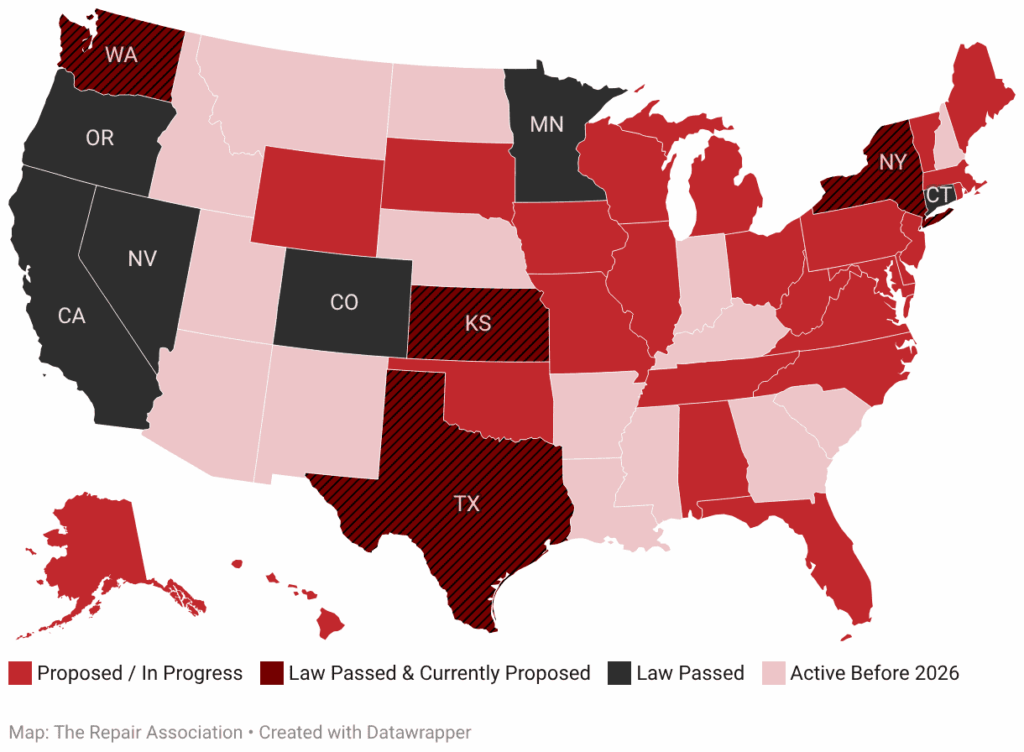
This is relevant, because such laws may eventually require companies to provide firmware updates. According to the Repair Association’s 2026 legislative template, the “tools” manufacturers must make available include “software, data files, activation mechanisms, and security credentials required to complete a repair.” Clearly, firmware fits the bill.
The update also prohibits manufacturers from conditioning access on serial numbers or proof of ownership. It takes time to build up legal precedent, and most of the focus is still on consumer devices. However, things may shift, and drive manufacturers will likely keep an eye out.
Reuse and the Drive Shortage
The need for firmware is sharpened by supply conditions. The AI supercycle has resulted in huge demand, and drive resellers are stepping in to provide a much-needed source of storage. The secondary market is increasingly important, especially for smaller organizations that cannot easily procure new drives at scale.
Indeed, the markets for recertified and refurbished drives have moved from aiding cost-optimization to meeting supply necessity. Clearly, a secondary market in which firmware status is far from transparent can be a risk for buyers who can no longer afford to treat casually.
What To Do
Here are some general tips on how to address difficulties in getting hard drive firmware updates.
Know Where To Look
If you’re lucky, the firmware updates will be available online. For example, Seagate has a firmware downloads page, which you can use if you have the drive serial number at hand. Exos, Mozaic 3+, and MakaraBP and MobulaBPP drives are all listed, but consumer drives are not. Seagate also has a Drive Detect tool which lets you identify drive model, serial numbers, and firmware revisions without removing your drive. There are separate firmware download pages for Corvault, Hybrid Flash Arrays, Integrated Storage servers, and JBODs. These all use Exos drives. If you got the drive as part of an array, however, you should opt for OEM firmware where preferable.
Buy Factory Recertified Drives
Factory recertified drives are reliable. In addition to being carefully retested, they are updated to the latest firmware before being resold. For example, authorized distributors such as Horizon Technology work with manufacturers to ensure drives they sell have the latest firmware updates.
For systems integrators where firmware version consistency matters — particularly in mixed-vendor arrays where backplane compatibility and drive interoperability are concerns — recertified drives reduce the risk of inheriting an unknown firmware history.
Understand Your Warranty Position
Always read the fine print! As the Seagate GitHub warning shows, updating firmware can have implications for your warranty status. In particular, drives which entered the resale market through server OEM channels might have firmware you cannot update. Treat this as a procurement risk management issue. When it comes to firmware status, it isn’t just the model number that matters: it’s the ownership history.
Use AI as a tool
AI can’t solve procurement issues, but it can sure make shopping easier. Jonmichael Hands provides an interesting example. “Pre-AI, going through a list of 3000 drives in health was not possible. Now, I just pop it in one prompt and say, give me a summary of these drives.”
AI tools can help purchasers get a grip on the status of large drive inventories. They can flag drives with anomalous health indicators, identifying firmware version patterns across a batch, and surfacing candidates for further investigation.
Firmware Access: The Road Ahead
When it comes to the secondary HDD market, firmware problems may not grab the most attention. However, these problems are crucial considerations for systems integrators who take reliability seriously. The combination of opaque policies, effective lock-in, warranty restrictions, and hard-to-navigate secondary markets means that many drives in circulation are running software of unknown quality.
Thankfully, this may be beginning to change: CDI is paying attention, right-to-repair legislation is introducing new expectations around software access, and AI tooling is making bulk drive assessment more tractable. If these trends bear fruit, then in the years to come, firmware may become more accessible.
Horizon is an authorized distributor of Seagate recertified drives, and has worked with Seagate for more than 25 years. Get in touch to find out how to buy drives in bulk.