






AI demand has redrawn the hard drive market. With nearline capacity sold out through 2026 and the Big Three openly chasing 100TB, the long-running capacity story is entering its next phase.
Three years ago the storage industry was wrestling with collapsing demand and excess inventory. Today the picture is reversed: hyperscaler appetite for high-capacity nearline drives has outstripped supply, and every major manufacturer has accelerated its roadmap. Seagate is shipping 44TB HAMR drives at scale, Western Digital (now WD) is in qualification on 40TB UltraSMR, and Toshiba has begun offering 30–34TB models. The goal across all three vendors is now 100TB. Here’s where the race stands.
From Rebound to Supply Crunch
The 2022–23 storage slump now reads as a footnote. While HDD unit shipments almost halved in 2022, by 2024 unit volume shipments of high-capacity nearline drives had rebounded an estimated 42% year-on-year, with overall shipped capacity rising 49% to 1.34 zettabytes. That rebound is now showing up emphatically in earnings: first-quarter fiscal 2026 revenue rose 21% at Seagate and 27% at WD.
Demand has overtaken supply
The fortunes of the major HDD manufacturers have now completely flipped compared to 2022. WD has said its 2026 HDD supply is effectively sold out, with firm purchase orders from its top seven customers and some long-term agreements already extending into 2027 and 2028. Seagate reports the same picture: its CEO has confirmed nearline capacity is fully allocated through calendar 2026. TrendForce had already reported by late 2025 that nearline HDD lead times had stretched from a few weeks to more than 52 weeks.
Increased demand is putting upward pressure on prices. In his latest full-year HDD industry update, Tom Coughlin reported continued HDD revenue growth into 2026 and noted that HDD ASPs were about 25% higher than at the end of 1998, driven by the shift toward high-capacity nearline drives.
AI is reshaping the capacity curve
The driver is AI infrastructure spending. Coughlin’s May 2026 analysis isolates the AI-incremental component of HDD demand and puts numbers on it: of the roughly 2,017 exabytes of HDD capacity expected to ship in 2026, around 363 exabytes, or 18% of the total, is demand attributable specifically to the AI buildout. By 2028 that share rises to 43%—by 2030, to 58%.
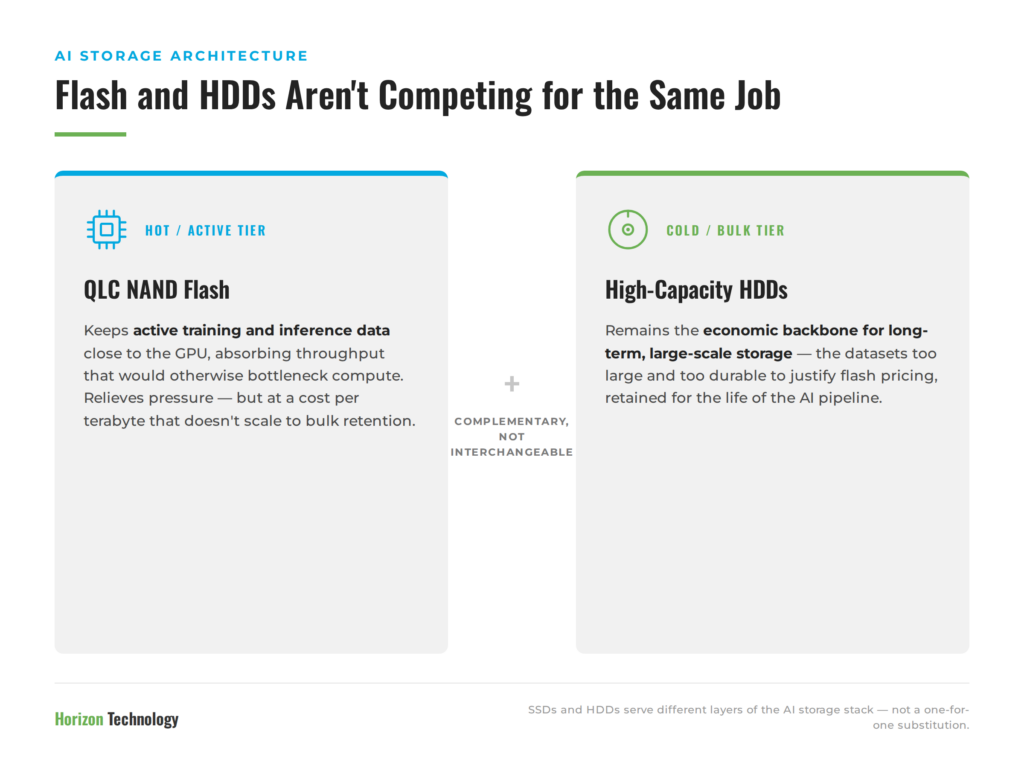
Hyperscalers are using QLC NAND SSDs to relieve some of the pressure, but SSDs and HDDs are not direct substitutes in the AI storage stack. Flash can keep active data close to GPUs, while lower-cost HDDs remain the better fit for long-term bulk storage.
Seagate: All-in on HAMR
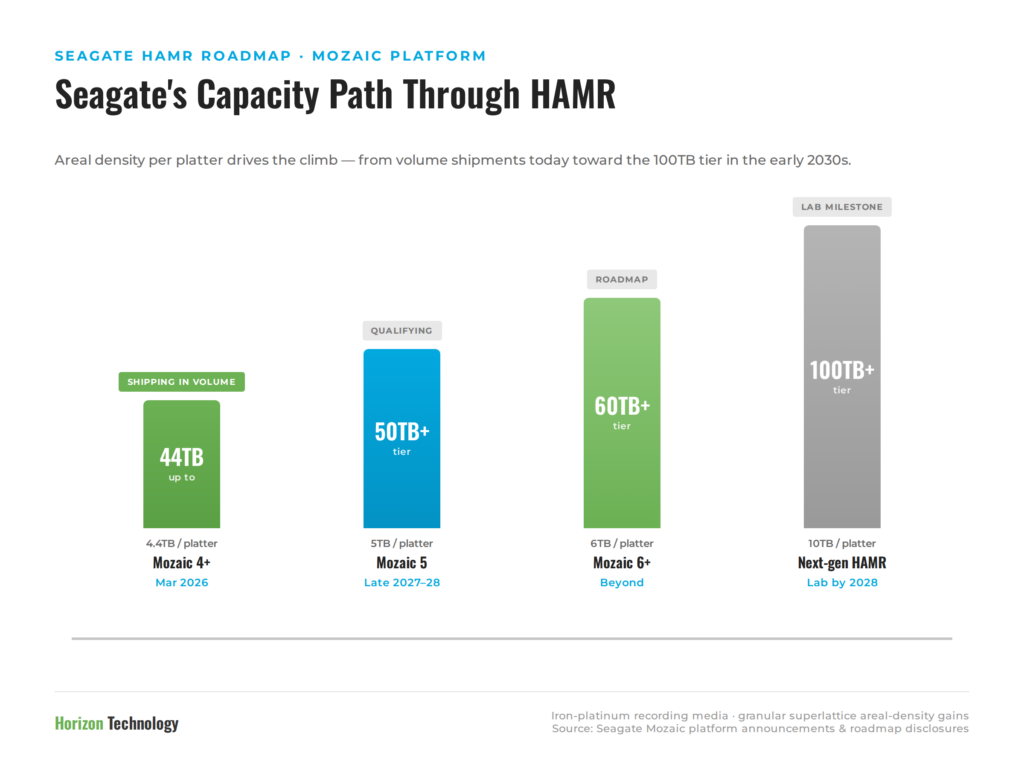
Seagate has the clearest strategy of the three, with every roadmap dollar pointing at HAMR. The bet is paying off. In March 2026, the company announced that its Mozaic 4+ platform—the only HAMR-based hard drive deployed at scale—is shipping in volume to two leading hyperscale cloud providers at capacities up to 44TB.
How it achieves this is impressive. The Mozaic platform packs 4.4TB onto each of ten platters using granular iron-platinum recording media, a superlattice formulation that supports finer magnetic grains and higher areal density.
From there, the roadmap is incremental: Mozaic 5, at 5TB per platter, is expected to qualify in late 2027 or early 2028, lifting capacities into the 50TB tier. Six terabytes and beyond per platter would follow, with a 10TB-per-platter milestone expected in the lab by 2028. Seagate’s CTO previously hinted at a path to 15TB per platter through “another level of extension” of the platinum media.
Owning the HAMR production stack
A second move worth noting: in March 2025, Seagate completed the acquisition of Intevac for $119 million. Intevac’s 200 Lean platform is the sputtering equipment used in at least 65% of the world’s HDD disk media production capacity, including the kind of advanced magnetic media production Seagate’s HAMR ramp depends on.
Bringing this in-house gives Seagate exclusive control of the critical media-deposition tooling its HAMR ramp depends on, and complicates HAMR adoption for competitors who would otherwise be Intevac customers. The structural advantage appears meaningful.
WD: ePMR and HAMR in Parallel
Western Digital—now officially WD, following both the SanDisk spin-off in February 2025 and a corporate rebrand at Innovation Day 2026—has taken a slightly different bet.
Rather than going all-in on HAMR, WD is pursuing a dual-path strategy: extend energy-assisted PMR as far as it will go, then transition to HAMR on a shared architecture once the technology economics close. The company says 90% of its revenue is now driven by AI and cloud customers, and its roadmap is built around giving those customers predictable capacity planning without forced technology transitions.
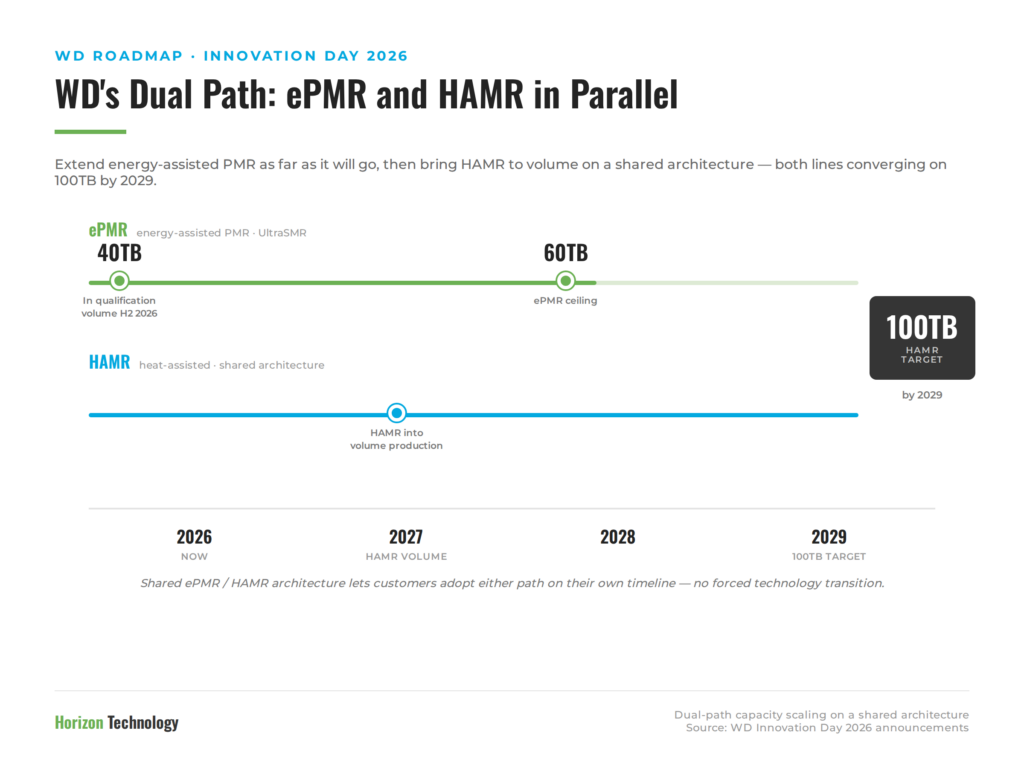
The near-term step is the 40TB UltraSMR ePMR drive, unveiled at Innovation Day 2026. The drive is currently in qualification, with two hyperscale customers running it through certification and volume production planned for H2 2026. Where Seagate’s 44TB is HAMR, WD’s 40TB is achieved on ePMR, with UltraSMR’s large-block encoding and error-detection algorithms compensating for narrower tracks. The trade-off is overwrite performance: UltraSMR is slower on certain write patterns, but for hyperscaler write-once-read-many workloads, the economics work.
Beyond 40TB, WD’s roadmap extends ePMR to 60TB and brings HAMR into volume production in 2027. The company is targeting 100TB HAMR by 2029, a more aggressive line than Seagate’s “early 2030s” framing. WD’s argument is that ePMR and HAMR share enough common architecture that customers can adopt either path on their own timeline, with no infrastructure disruption.
Expanding performance as well as capacity
The other thread in WD’s Innovation Day announcements is performance. Two new technologies—High Bandwidth Drive Technology and Dual Pivot Technology—target the AI-workload performance gap that has historically pushed hyperscalers toward flash. High Bandwidth Drive reads and writes from multiple heads on multiple tracks simultaneously, delivering 2x current HDD bandwidth with a roadmap to 8x. Dual Pivot adds a second independently operating actuator on a separate pivot for 2x sequential I/O, and reduces inter-platter spacing to enable additional platters per drive.
Combined, the two technologies aim for 4x sequential I/O at 100TB capacity, flash-like throughput at HDD economics. WD claims this redraws the boundary between HDD and SSD for AI training and inference, where 6–10x flash price premiums and endurance limits have constrained adoption.
Toshiba: The Step-By-Step Approach
Toshiba’s strategy is the most conservative and perhaps the most quietly interesting. Rather than racing into HAMR, the company has stretched mechanical and recording innovation as far as the existing technologies will go, with HAMR slated for later in the decade as the final step.
The cleanest illustration: in October 2025, Toshiba became the first vendor to verify a 12-platter stacking design within the standard 3.5-inch enclosure, breaking past the 10-platter ceiling that has held for years. The breakthrough required replacing aluminum platter substrates with glass (thinner, more dimensionally stable, more durable) and refining the actuator geometry to handle the additional disks.
Within five months, the resulting product was in market: in April 2026, Toshiba began shipping its M12 Series of 30–34TB MAMR + SMR drives for hyperscale customers. Notably, the M12 still uses its FC-MAMR and SMR technology on glass-substrate media, rather than moving to the FePt-based HAMR media stack used for heat-assisted recording.
Stretching MAMR before the HAMR shift
The firm’s capacity roadmap continues in a similar manner. Toshiba is targeting a 40TB MAMR drive on 11–12 platters in 2027, a 45TB drive in 2028, and 55TB or more after 2029, with HAMR taking over from MAMR as the capacity ladder climbs.
HAMR adoption will likely grow more meaningfully after 2029, by which point Toshiba’s 12-platter MAMR platform will already have carried much of its nearline roadmap toward the 40TB and 55TB classes. In effect, Toshiba is using mechanical scaling and MAMR to defer the highest-risk parts of the HAMR transition rather than making HAMR the first step.
The Road to 100TB and Beyond
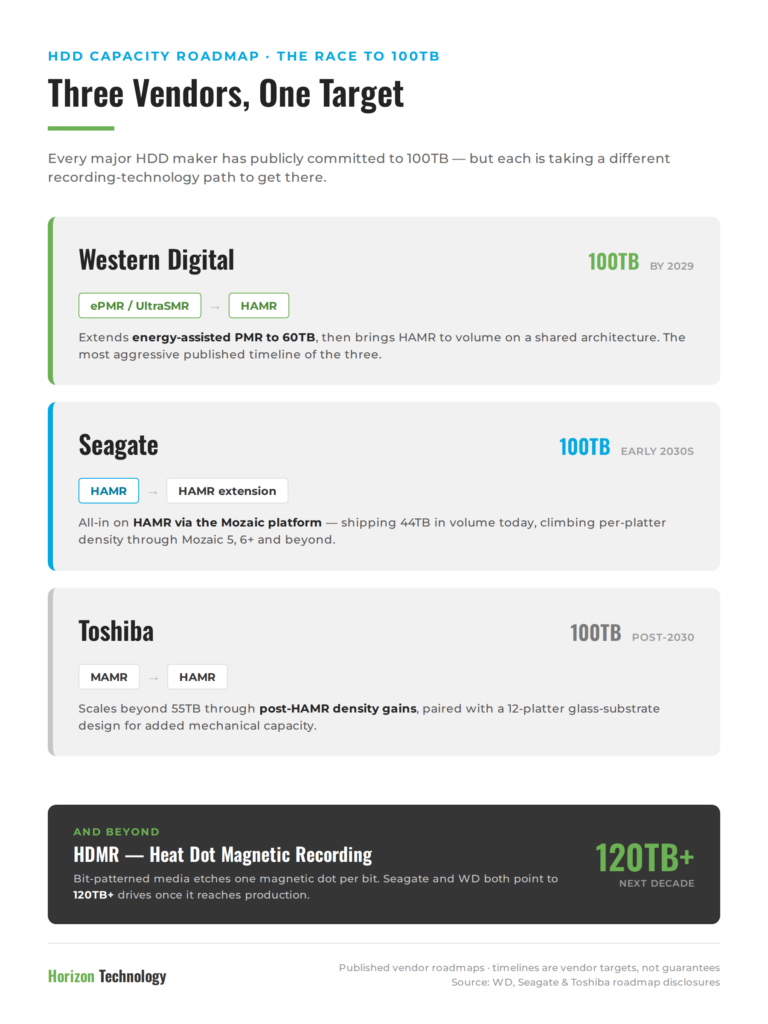
100TB is now the published target every vendor has publicly committed to: WD by 2029, Seagate in the early 2030s, and Toshiba through post-HAMR scaling beyond 55TB. The path to that milestone runs through three overlapping technology dimensions.
Recording media will carry the next density gains
Granular iron-platinum HAMR media is expected to remain viable through several capacity generations, comfortably to 10TB per platter, and possibly to 15TB per platter with further extension. Beyond that, both Seagate and WD now openly point to Heat Dot Magnetic Recording, or HDMR, which combines HAMR’s laser-heating approach with bit-patterned media.
In HDMR, individual magnetic dots are lithographically etched onto the platter as discrete, thermally stable storage cells: one grain per bit, rather than the random clusters used in current HAMR. WD expects HDMR within the next decade and projects areal densities of 8 terabits per square inch and capacities well beyond 100TB. Seagate points to 120TB+ drives once bit-patterned media reaches production.
Mechanical engineering still matters
The second dimension is mechanical scaling. Toshiba’s 12-platter glass-substrate design is one route. WD’s Dual Pivot Technology is another. By reducing the space between platters to add disks, the same drive envelope can hold more capacity without requiring an immediate recording-density breakthrough.
Performance may be the real gating factor
The third dimension is performance. A 100TB drive at today’s HDD I/O rates would create a workload bottleneck that defeats much of the capacity gain. WD’s High Bandwidth Drive and Dual Pivot technologies target this directly, aiming for flash-like throughput at HDD cost. Seagate’s multi-actuator designs serve a similar purpose. Whether 100TB drives reach hyperscale data centers usefully may depend as much on these performance technologies as on the capacity headline.
The Race Is Now
Three years ago the open question was whether hard drives would remain economically relevant against falling NAND prices. In 2026 that question has been answered, decisively, by the arithmetic of AI training data. Spinning media remains the only storage medium that meets the cost and scale requirements of multi-zettabyte datasets, and demand for it has outstripped supply across all three remaining manufacturers.
The race is now about how fast the industry can scale to a 100TB-class nearline drive, and which combination of HAMR, ePMR, MAMR, glass platters, bit-patterned media, and multi-actuator engineering gets there first. What customers buy in the meantime is the bridge: 30TB-class drives from Toshiba, 40TB UltraSMR from WD, 44TB HAMR from Seagate. And what every vendor is racing for is the right to define the next decade of nearline storage economics.