





In today’s rapidly evolving technology landscape, e-waste and embodied carbon remain significant concerns. This is especially true as precipitous demand for all things artificial intelligence (AI) leads to soaring data storage requirements.
In the face of these challenges, the Circular Drive Initiative (CDI) embraces circularity principles to curb e-waste in data storage hardware. It draws inspiration from strategies that aim to minimize waste by maximizing the lifespan of products and materials. Specifically, it advocates for sustainable hardware mechanisms using system-based approaches that take into account the entire product lifecycle.
As data storage enters a new phase, CDI is uniting storage industry leaders in a push to minimize environmental impact, tackle resource security issues, and promote secure reuse. By encouraging companies to adopt long-term strategies, CDI is at the forefront of the drive towards sustainable data storage.
The Story
The Circular Drive Initiative operates as a consortium uniting global leaders in digital storage, data centers, sustainability, and blockchain. The CDI’s core mission revolves around fostering sustainability in storage practices, combating e-waste by championing, enabling, and advocating for the secure reuse of storage hardware.
CDI was convened in November 2022 under the leadership of William McDonough, an architect renowned for his work on circular design and the development of the “cradle-to-cradle” principle. The consortium brings together a dream team of industry leaders to formulate and implement sustainability strategies. Members include prominent drive manufacturers like Seagate together with memory leaders such as Micron and eco-friendly blockchain groups.
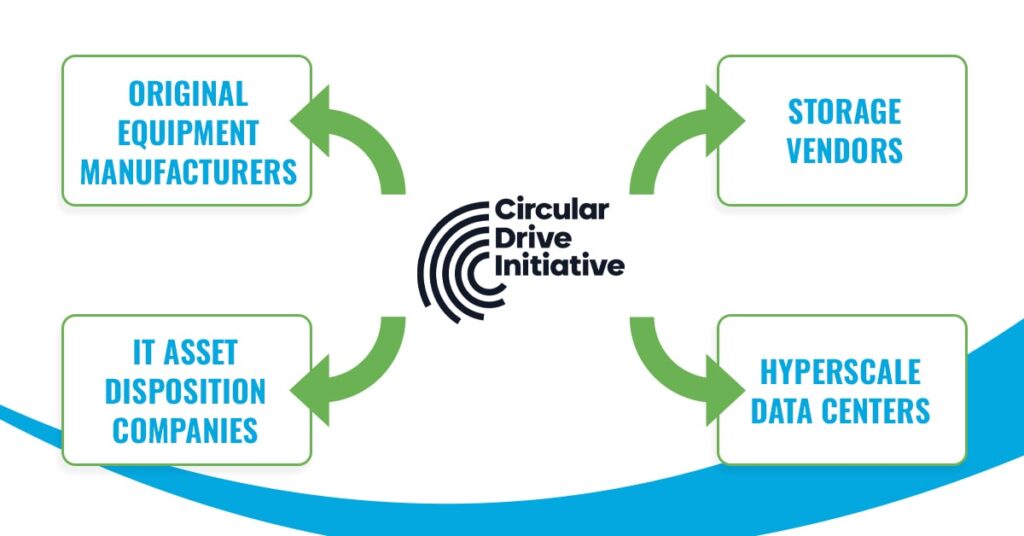
As an inclusive coalition, the Circular Drive Initiative welcomes storage vendors, hyperscale data centers, original equipment manufacturers, IT asset disposition companies, and anyone else passionate about making a meaningful impact in sustainable data storage.
“CDI is the only place where drive manufacturers, hyperscalers, OEMs, and ITADs can get together to really tackle the barriers to circularity, including storage security and media sanitization education,” remarked CDI chair and storage industry leader Jonmichael Hands.
The Strategies
Eliminating e-waste is a multifaceted goal. Thankfully, companies can tackle it by using several circularity practices in tandem. In addition to promoting industry education around sustainability issues, key practices include:
- Developing new sanitization standards
- Implementing circular business models
- Promoting drive reuse and resale
- Encouraging the extension of HDD lifecycles
- Discouraging first-use destruction
- Fostering impact and accountability
The circular economy model prioritizes efficiency by prolonging the utilization of resources and minimizing waste. Its scope extends far beyond mere recycling. While recycling is ultimately a necessary step in the circularity process, a 2020 study showed that extending the life of a device — rather than disposing of it prematurely — can result in a 275x difference in overall carbon impact. A truly circular economy entails the comprehensive tracking of drives throughout their lifespan to facilitate extended usage in tandem with responsible recycling.
Smooth collaboration is key to implementing these initiatives, and CDI benefits from a robust network. In addition to manufacturers, its members comprise leading ITAD companies and distributors, including Horizon Technology.
CDI’s mission is to promote the reuse of drives by educating end users and creating de facto test and data sanitization standards. This helps remove any questions and concerns around the reuse of drives.
Stephen Buckler, chief operating officer of Horizon Technology
The Outreach
Growth in the Internet of Things (IoT) and AI applications means storage is needed for increasingly massive data sets. This also highlights the critical role of storing data not just sustainably, but securely. The more data you store, the greater the chance that sensitive data is leaked when a drive is improperly disposed of. The problem is that misunderstanding what security requires leads to unsustainable practices. As CDI puts it, the current state of play for the industry is “we shred everything.”
As is so often the case in industry, clear communication is half the battle. Effectively addressing such sensitive issues as safety and privacy necessitates the distribution of credible, decisive information.
The White Paper
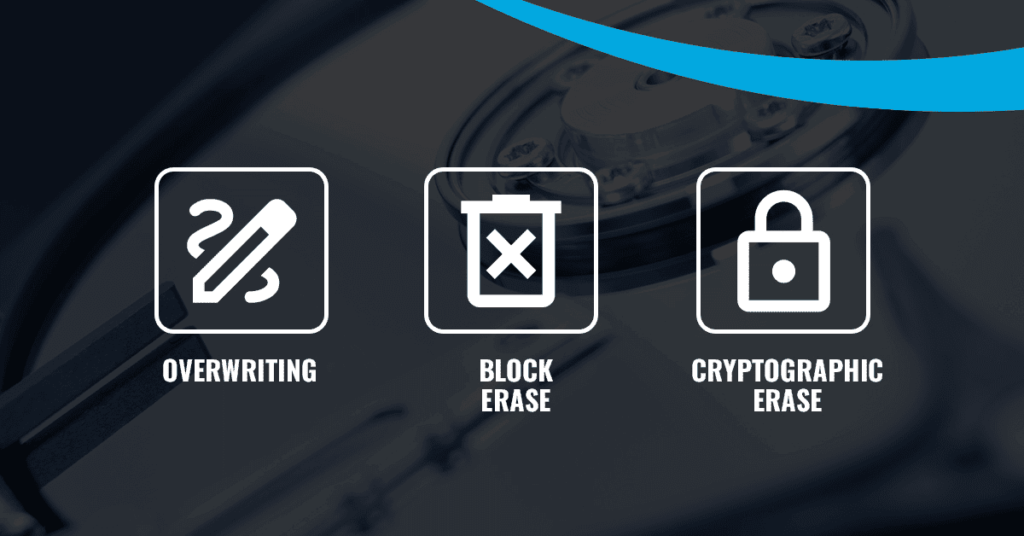
To this end, the CDI published a white paper together with the Open Compute Project (OCP). Entitled “Data Sanitization for the Circular Economy,” the report highlights the use of ‘purge media sanitization.’ Purge involves rendering data recovery infeasible through laboratory techniques while maintaining the drive in a reusable state.
Related Reading
Done right, purge media sanitization lets you have your cake and eat it too. Data is rendered unrecoverable, while the drive is left in a potentially reusable state.
Promoting awareness of purge sanitization is paramount, since concerns about data security often become barriers to achieving circularity. Currently, data centers destroy up to 90% of storage devices after first use due to these security concerns. According to the white paper’s executive summary, “this eliminates the possibility of a circular economy because it prevents any further uses of the devices”.
As a remedy, the white paper focuses on the IEEE 2883 standards. “Media sanitization is a well-researched and understood field”, the report authors argue. New standards reflect state-of-the-art ITAD techniques, and make it clear that best practice is not necessarily shredding.
The Guide
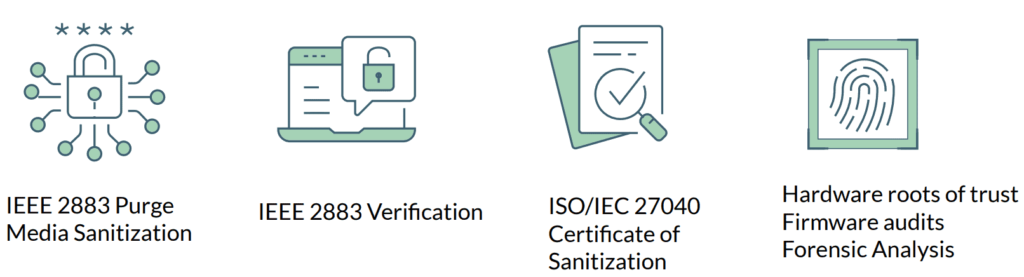
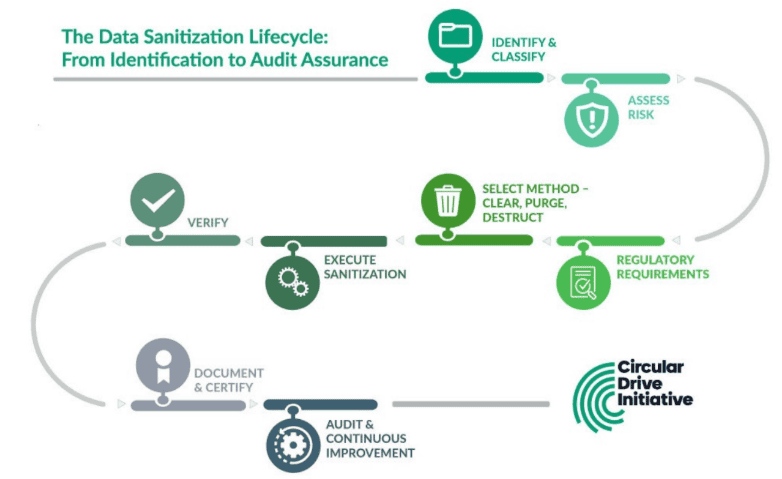
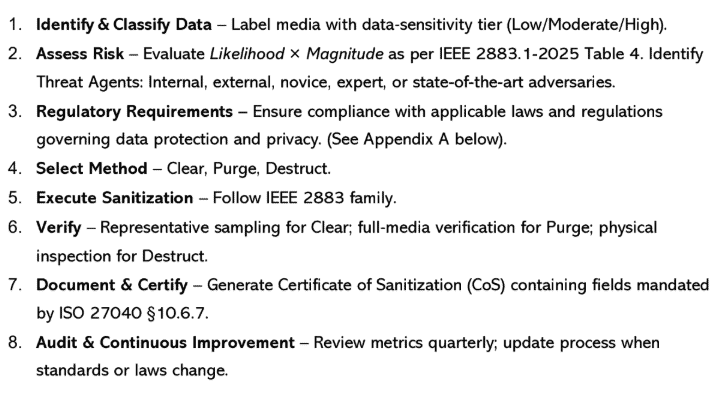
More recently, the CDI released a guide, “Data Sanitization Best Practices“. The guide aligns with standards IEEE 2883, ISO 27040, and NIST 800-88, and highlights regulatory considerations such as GDPR, CCPA/CPRA, and HIPAA.
A picture is worth a thousand words, so the document provides a handy visual guide to the data sanitization lifecycle:
The document then adds to this by explaining which standards are relevant to each stage:
As with the whitepaper, the goal isn’t to reinvent the wheel. It’s to promote and publicize responsible sanitization practices in a way that keeps data secure while avoiding unnecessary e-waste. CDI Chair Jonmichael Hands sums it up as follows: the guide “enables secure reuse at scale while ensuring organizations never have to choose between strong data protection and environmental responsibility.”
Innovation in Sustainable Data Storage
The CDI’s agenda is clear: extend first use, encourage purging over destruction, and enable resale. With the release of the IEEE 2883 standard, there’s good reason to hope that the message of reuse will more easily reach the ears of organizations and thought leaders.
Bringing Industry Together
This will be achieved by bringing together the best and brightest minds in the industry to address implementation challenges and communicate solutions. After all, when it comes to circularity, reuse significantly mitigates carbon impact and extends value recovery.
“Currently CDI is working on comprehensive guidelines for media sanitization, heavily leveraging and prioritizing the IEEE 2883 specification and work,” Hands explained. “We are also working on open-source software for health grading to enable more transparency and understanding of device health and reliability in the secondhand market.”
CDI membership is also growing, with the consortium expecting to add more big names to its roster.

New Technology
Additionally, new technical advancements will play a critical role in shaping sustainability infrastructure and practices in the future. Technologies like self-regenerating drives, for example, will create new opportunities for extending hardware lifecycles.
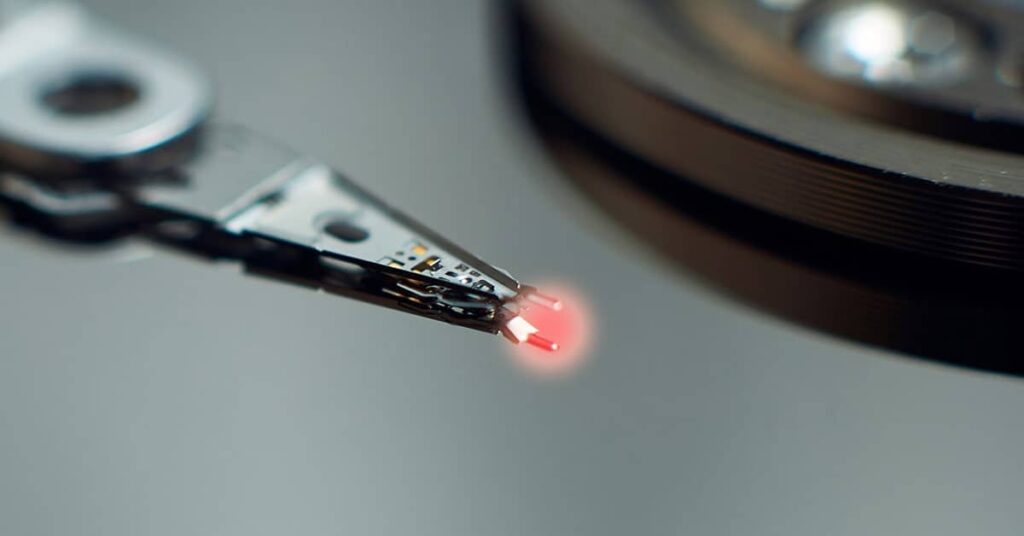
HAMR (Heat-Assisted Magnetic Recording) drives are another solution that may revolutionize the HDD industry as they become more widespread. This technology uses a laser to heat a tiny spot on the disk, allowing data to be written in smaller and more densely packed bits. “A 20 TB drive and 32 TB HAMR drive share the same carbon footprint, both in embedded emissions from manufacturing and power consumed in its lifetime” claimed Seagate, a pioneer in HAMR development.
However, caution is in order. When it comes to destruction, increased areal density means that shredding is now more risky, since tiny fragments of drive can still hold a lot of data. Melting and incineration work, but take more power. Hopefully, this will help push companies towards secure purge methods, as they pursue power savings while maintaining security.
Related Reading
HAMR drives are leading the way when it comes to upping areal density in HDD platters. Denser storage is more sustainable in the long run, drawing less power overall.
The Future of Sustainable Data Storage
The Circular Drive Initiative champions circular economy principles to combat e-waste, minimize environmental impact, and drive sustainable growth in sustainable data storage. By uniting global leaders and advocating for secure reuse, CDI addresses pressing concerns of e-waste and carbon emissions in the technology landscape. Its comprehensive strategy — encompassing standards development, circular business models, industry education, and responsible recycling — seeks impactful change.
Through clear communication and partnerships like with the Open Compute Project, CDI emphasizes ‘purge media sanitization’ as a means to securely erase data, enabling secondary use. Looking forward, CDI remains committed to extending first use, promoting purging over destruction, and facilitating industry-wide adoption. Technological advancements, including self-regenerating drives and HAMR technology, hold promise for more sustainable, more efficient storage solutions.
As demand for data storage accelerates, shaping a sustainable future for storage technology through collaboration, innovation, and knowledge sharing has never been more timely or pressing.
Find out how Horizon can help make your data center more sustainable while reducing total cost of ownership.