





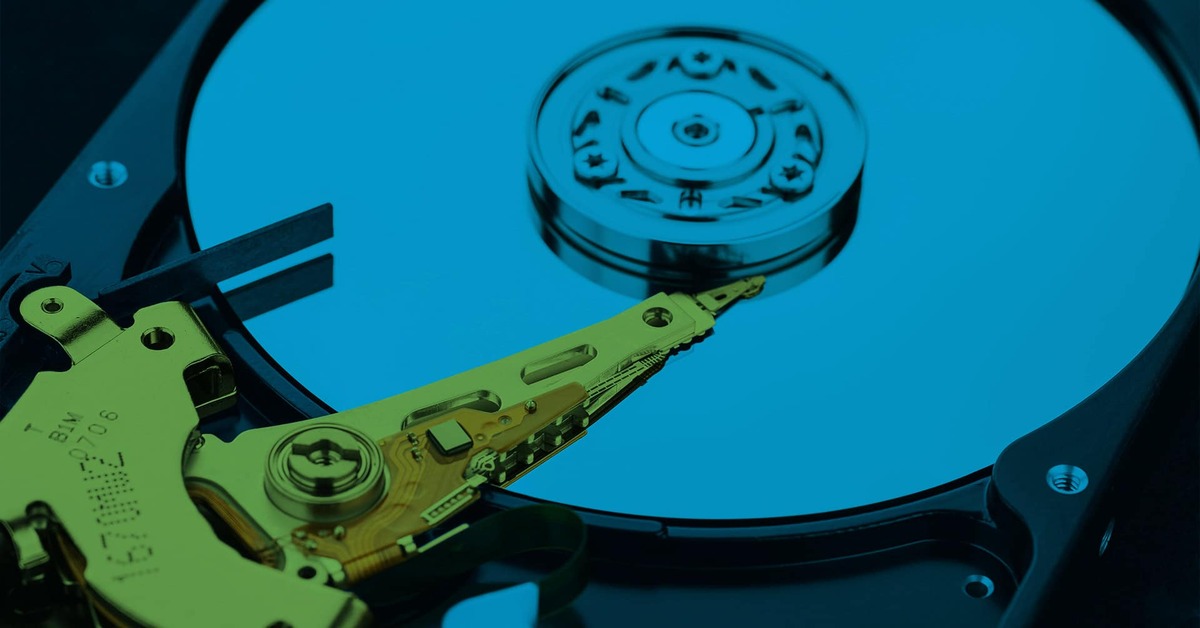
In an HDD, the task of positioning the read-write head falls to the hard drive actuator assembly, which moves the actuator arms to which the heads are attached. Positioning and holding the read/write head accurately isn’t easy when billions of bits are spread over platters revolving thousands of times per minute. The fact that all this takes place in a confined space with hundreds of other component parts makes actuator design a challenge for disk manufacturers.
However, manufacturers have no shortage of tricks up their sleeves for meeting this challenge, and actuator technology has come a long way. New approaches include adding extra joints, adding extra actuators, and making the assembly more compact. These innovations enhance the speed, accuracy, bandwidth, and reliability of the actuator assembly to meet the ever-growing demands of storage customers.
Inside the Hard Drive Actuator Assembly
In mechanics, “actuator” is a general term for any device which converts energy into motion. In this case, the hard drive actuator, typically a voice coil motor, moves and positions the actuator arm. When it comes to aligning the read/write head, exceptional accuracy and speed are necessary for drive performance.
The whole moving apparatus, including the pivot, the motor, the arm, and the read/write head is known as the actuator assembly (or, alternatively, the head-stack assembly). Here’s a rule-of-thumb for hard drive components: if it moves, and isn’t the spinning disk or spindle, then it’s part of the actuator assembly.
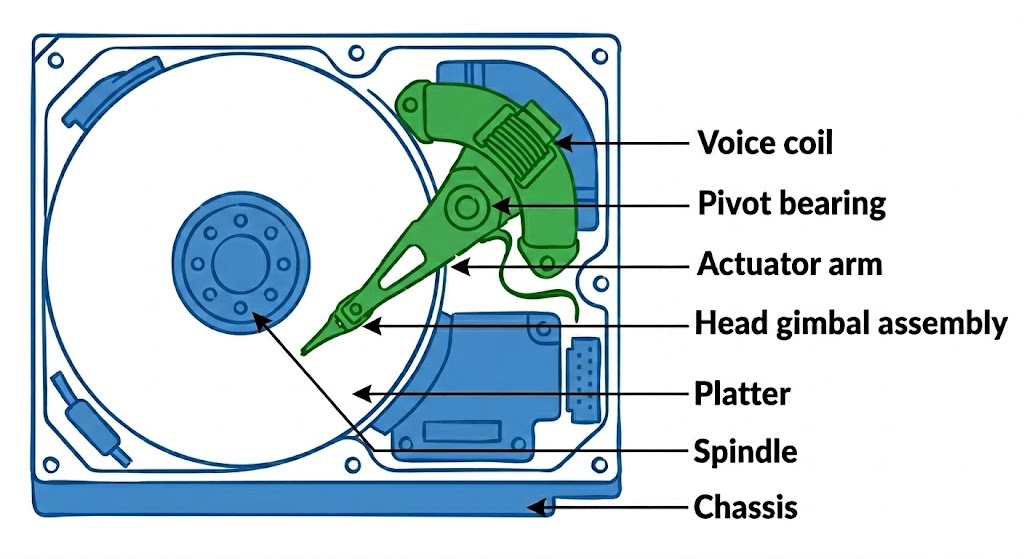
The actuator assembly is governed by the HDD controller, which you can think of as the center of communication between the computer, the read-write head, and the actuator itself. This controller guides the actuator arm by translating signals between the CPU and the actuator through a subsystem called the voice coil controller. Beyond that, the HDD controller synchronizes the platters and the actuator assembly, manages data transfer, and handles error correction.
Related Reading
The actuator assembly design impacts performance, but when it comes to density, platters are paramount. Platter design plays a key role in enabling high-cap storage and reducing cost-per-TB.
What Goes Into Hard Drive Actuator Assembly Design?
Hard drives contain multiple platters stacked closely together, and read/write arms must be able to seamlessly navigate between them. Meeting this design challenge and ensuring that an actuator assembly performs well over an HDD’s whole life-cycle requires careful design. Ultra-high precision and speed are key to overall HDD performance, since malfunctions can result in corrupted or lost data.
Stepper Motors
In the early days of the technology, HDDs used stepper motors as part of the actuator assembly. These motors moved the hard drive actuator arm to the desired location by converting digital signals into mechanical displacement.
While initially workable, stepper motors became inadequate as the areal density of HDD platters increased, since narrower tracks and closely packed magnetic bits require more accuracy than stepper motors allow. Another issue was that stepper motors generate heat, which could cause platters to expand just enough to risk a head crash—when the read/write head comes into physical contact with the HDD platters.
Voice Coil Motors
To overcome these limitations, the industry moved to the now standard voice coil motors, which are integrated into the actuator assembly using a servomechanism. A servomechanism is a feedback loop that continuously monitors and adjusts the actuator arm based on real-time inputs, ensuring that the read/write head remains in perfect alignment. The transition to voice coil motors led to a significant improvement in HDD performance, and enabled higher storage capacities by allowing the use of complex data structures on the HDD platters.
Reliability
Like all mechanical parts, actuator assemblies have limitations and are vulnerable to failure. Over time, they can become misaligned or just fail to work. This could be due to several factors, such as wear and tear of components, gradual misalignment, or the malfunction of any one of the interconnected parts. When the assembly malfunctions, the consequences can be severe for the integrity of the HDD. Users might hear strange noises from the drive, experience data corruption, or even suffer permanent data loss due to a head crash.
These challenges underscore the need for a reliable actuator assembly design. To meet these challenges, HDD manufacturers like Seagate, Western Digital, and Toshiba design and manufacture their assemblies in-house, apart from a few specialized components. Technological innovations in design like Seagate’s multi-actuators or WD’s triple-stage actuators give them a competitive edge in a market that constantly demands higher capacity and speed.
Related Reading
While the actuator moves the read/write arm, the spindle is what puts the spin in disk media. Achieving high rotation speeds in a compact space is key to overall drive performance.
More Actuators for a Faster Future
While HDDs are preferred for reasons of cost, rather than speed, throughput still matters. This is especially true for hyperscale data centers and commercial enterprises that must maintain high levels of performance without compromising capacity. To address these performance requirements, some manufacturers have introduced multi-actuator technology. As the name suggests, these incorporate more than one actuator into a single drive.
Seagate: Dual-actuators
A leading example is Seagate’s MACH2 drives, which employ two independent actuators operating simultaneously. This setup creates a parallel system of two concurrent channels for data input and output. It effectively doubles the IOPS (input/output operations per second) rate by allowing data access from two sections of the drive at the same time.
This “dual-actuator” consists of two independently moving parts which share a single pivot.
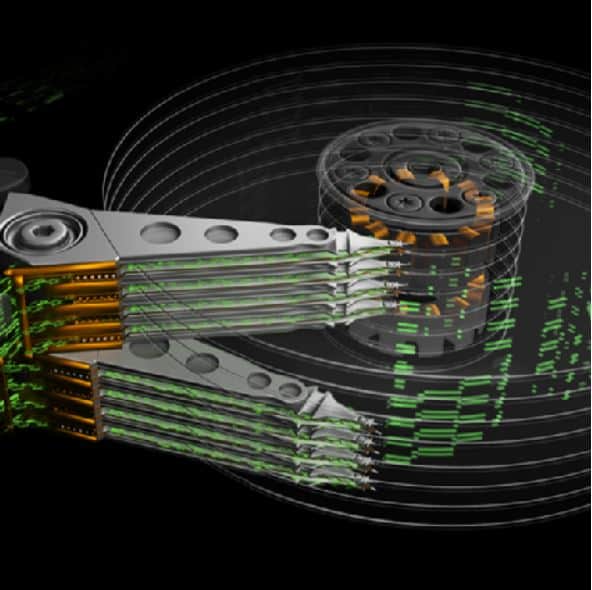
Compared to single-actuator drives, Seagate reports high performance gains in parameters such as random reads, high transfer size (128KB+) random writes and sequential reads/writes. These performance parameters make dual-actuator drives ideal for demanding applications like content delivery networks, video streaming, and cloud applications. Beyond speed, this technology also enhances the relative power efficiency of the drives.
Western Digital: Dual Pivot Technology
With both standard setups and Seagate’s dual-actuator variation, there are actually two head gimbal assemblies present when an actuator arm is between two disks. The first head faces upwards to read/write the bottom of the platter above, and the second head faces downwards to read/write the top of the platter below.
This standard approach has two drawbacks. Firstly, it means that the hard drive cannot read data on opposite ends of the disk at once. Secondly, having two opposite-facing head gimbal assemblies so close together requires space between the platters.
To solve this problem, Western Digital is taking a different approach: “Dual Pivot Technology”. True to its name, this design involves two separate actuator assemblies.
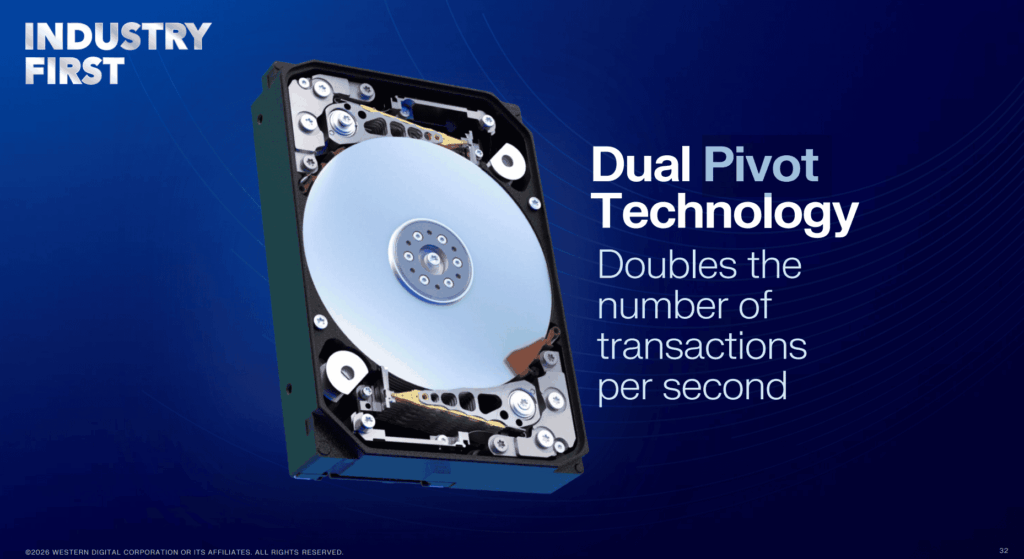
A dual-pivot drive will contain the same number of heads, but these will now be evenly distributed across the two actuators. This eliminates the need to have opposite-facing head gimbal assemblies in close proximity, allowing manufacturers to reduce the space between disks. WD claims that this new approach will double hard drive bandwidth.

Related Reading
Western Digital’s Dual Pivot Technology is part of its strategy to achieve 8x HDD bandwidth by 2030. This, together with the low cost of HDD, will help spinning media fend off competitors looking to increase SSD’s warm tier storage market share.
Multi-Stage Actuators
The Need for Precision
Rising areal density in storage media means that the space between the stored bits keeps shrinking, requiring extraordinary precision by the actuator assembly to position the read/write head.
For example, in a 2.5 inch HDD, the components are packed tight with such a slim margin of error that sound vibration from built-in laptop speakers can cause head misalignment. Furthermore, the actuator arm moves over the platters’ concentric tracks in an arc, creating alignment challenges between the tracks and the read/write head. This is particularly true when the head moves towards the inner and outer edges of the circular platters.
The Multi-Stage Solution
To overcome these complications, modern HDDs employ multi-stage actuators (not to be confused with multi-actuators) by integrating supplementary pivots in the actuator arm along with the voice coil motor. Think of these as extra “joints” in the actuator arm. The additional pivots enable ultra-precise control of the read/write head positioning.
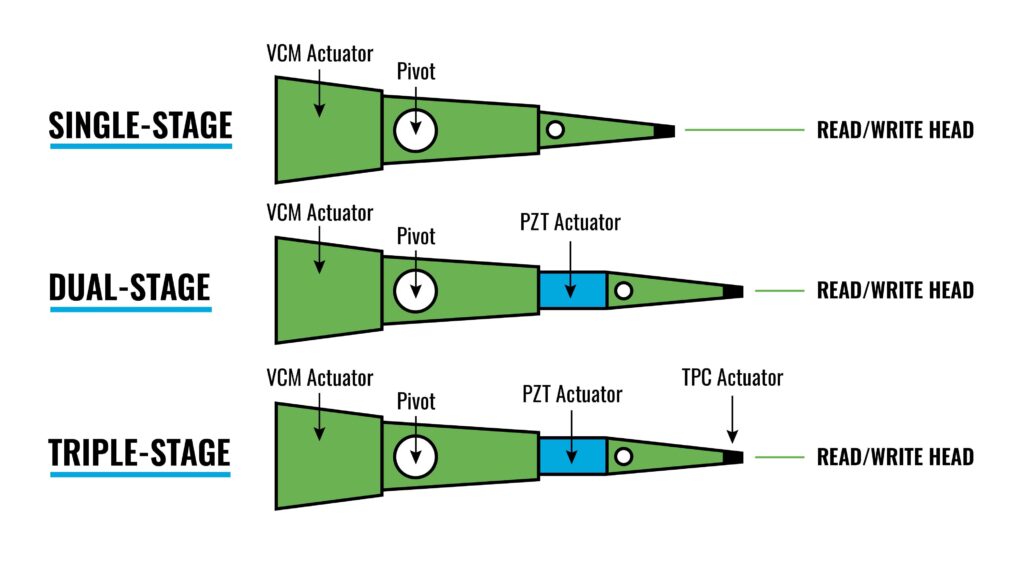
Western Digital’s dual-stage and triple-stage actuator technologies illustrate this advancement. A dual-stage actuator initially incorporated a milli-actuator as a secondary pivot point, allowing adjustments as fine as 200 nm. Later on, an upgraded dual-stage actuator replaced a milli-actuator with a micro-actuator, which is capable of adjustments of 100 nm. “If you think of it like driving on a curving, multilane highway, the first-stage actuator puts you on the highway, and the second, fine-tuning stage keeps you centered in the correct traffic lane” explained WD in its whitepaper.
Eventually, triple-stage actuators combined both milli-actuators and micro-actuators to provide three pivot points in a single-actuator assembly. These supplementary actuators rely on piezoelectric (PZT) elements to execute micro-adjustments. The piezo elements expand and contract enabling minute repositioning of the read/write head once the voice coil motor positions the actuator arm. Additional actuators also mitigate internal and external vibrations, making sure the head remains in position.
In addition to improving read/write head positioning accuracy, multi-actuators enhance HDD performance. Faster and more precise head movements boost overall speed of the drive, which is essential in managing high-density data. The pin-point accuracy of a multi-stage actuator also lets manufacturers pack together data tracks and bits without increasing error rates.
Related Reading
While flash is a natural fit for low-latency operations, the role of HDD in nearline storage at scale is secured, at least for now, by its lower cost-per-TB.
A Call to Arms
Hard drive actuator assemblies have come a long way from the days of simple stepper motors. As storage densities increased, voice-coil motors changed the game, addressing the need for better precision and heat management. Today, the demand for greater capacity and performance is pushing companies to innovate further by developing dual actuators, dual-pivot actuators, and multi-stage actuators.
Advancement in actuator assembly technology has a wide-ranging effect on hard drives. It not only enhances speed but also pushes the frontiers of higher storage capacities. At the same time, it support HDD reliability by safeguarding data integrity, which is critical for both consumer and commercial applications. This helps HDD remain competitive in an evolving data landscape, with actuator assemblies playing a key role in keeping HDDs relevant.
At Horizon Technology, we know all about data center HDD. For practical support with procuring drives, get in touch and find out how we can help.