






When it comes to tiering and data centers, flash dominates “hot storage”: those use cases where low latency is a must. Meanwhile, the low cost of nearline HDD has allowed spinning media to retain its dominance in warm tiers, especially in hyperscale operations. However, warm tiers are contested by high-cap SSD. The competition has only grown more heated during the current supply crunch.
Most coverage of hard drives tends to focus on density and cost. Western Digital is trying to shift this narrative with an innovative strategy. The firm recently announced a plan to increase hard drive bandwidth 8x by 2030. It claims that this bandwidth increase, in combination with other techniques to bolster performance, will lead to a considerable cost advantage over SSD for warm tiers.
For the use cases which constitute the disputed tiers, increased bandwidth can help hard drives keep flash from eating into its market share. The question is whether WD will be successful in making good on promised innovation while keeping costs low.
Keeping Up With the Joneses
High-performance flash has the monopoly on write-intensive operations, while nearline HDD remains ubiquitous wherever warm storage is needed at scale. But especially in times of tech shortages (like today), much ink is spilled over the battle between HDDs and QLC NAND over intermediate tiers of data.
The shortages, which have affected both HDDs and SSDs, have been largely driven by the AI boom. AI workloads require a massive amount of storage for the data used in training and inference. In particular, there is increased competition over read-intensive workloads where frequent rewriting is unnecessary. Such workloads include AI inference, and also handling large object storage workloads like media streaming and video surveillance.
In the past, bandwidth has been one of several considerations that have pushed consumers towards SSDs. For example, a year ago Meta was seriously considering a mid-tier of QLC (Quad Level Cell) SSDs between HDD and high-performance TLC (Triple-level cell) flash. They made the move because of the decreasing bandwidth-per-TB of hard drives. This downward trend had forced Meta to resort to overprovisioning, or storing more data on the high-performing but pricey TLC tier. The company suggested QLC might offer a way out.
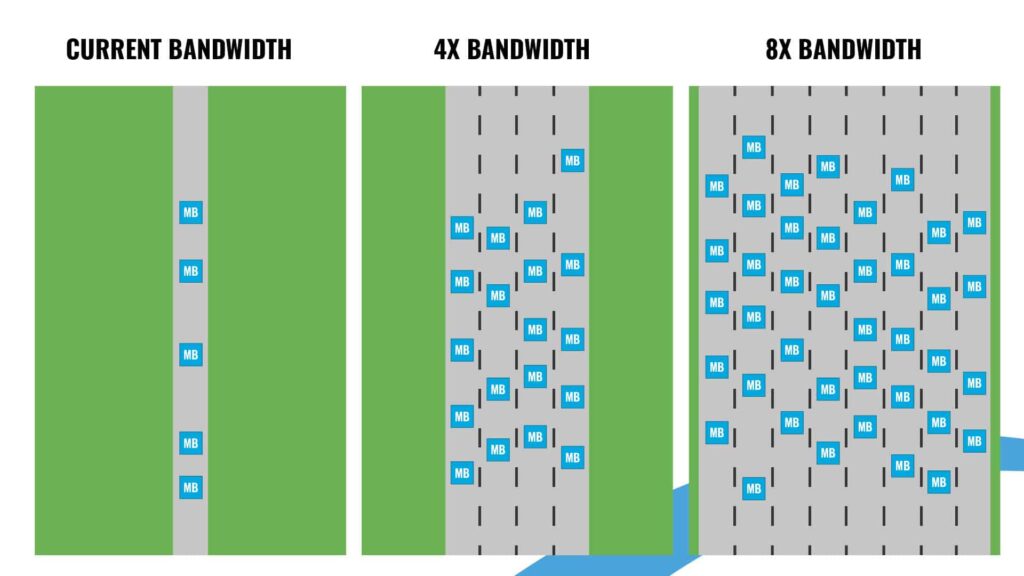
HDD’s low bandwidth has led to pessimism about the long-term prospects of spinning media. Consider, for example, a late-2024 pro-SSD analysis by analyst Chris Mellor. He argued that one can replace 23 4U racks of HDD with a single 40U rack of 122TB SSD and get 54x read bandwidth.
In other words, bandwidth is an oft-overlooked sticking point for HDDs in their competition with SSD over a disputed storage middle-ground. Increasing bandwidth removes this obstacle, strengthening the case for HDD.

Related Reading
The world of data storage hardware is changing fast, and the moves that HDD OEMs make now will affect the course of storage for years to come. What will the storage mix look like in 2030?
WD’s Bandwidth Strategy
In an “innovation day” investor event in early February, Western Digital presented its novel strategy to increase the bandwidth of its HDD products. The big goal: achieving 8x bandwidth by 2030. This is with respect to a baseline bandwidth of 300MB/s. What’s more, WD has a head start: The firm has already demonstrated 2x bandwidth.
The How
The planned 8x increase in bandwidth will be enabled by two technologies. While hard drives have at least one read head per platter, they do not generally operate at the same time. WD’s “High Bandwidth Drive Technology” (HBT) will allow simultaneous read/writes from multiple heads and multiple tracks. Meanwhile, its “Dual Pivot Technology” adds a second set of actuators on separate pivots.
WD’s High Bandwidth Drive Technology already figures in its drives, enabling 2x bandwidth. The Dual Pivot Technology will become available around 2028. This will further double bandwidth, for a 4x total. The company will then continue honing these technologies in order to reach an 8x bandwidth of 2.4GB/s by 2030.
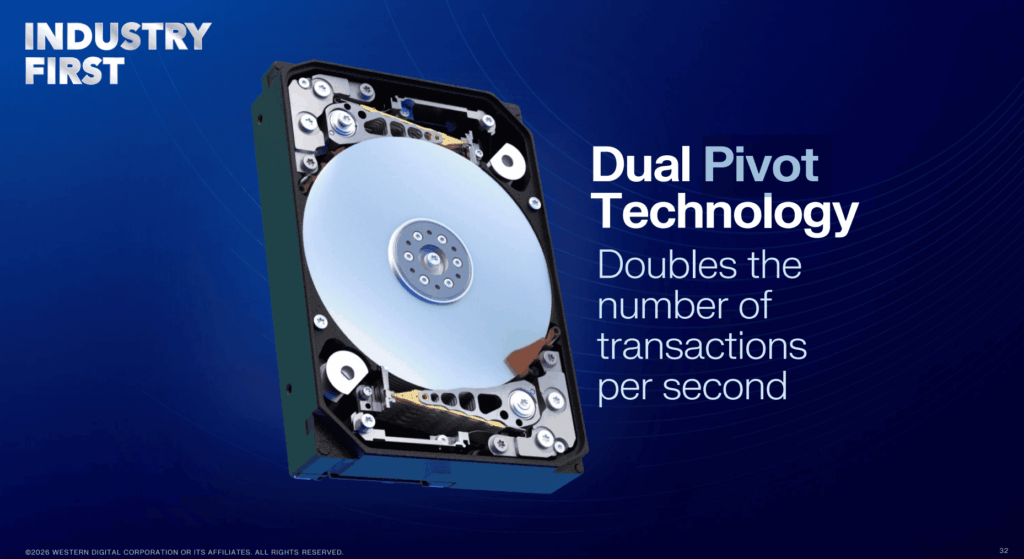
Interestingly, Dual Pivot Technology actually reduces the space between drive platters. This is because the tip of a read/write arm is usually double-headed, with one head reading/writing the bottom of the disk above and another reading/writing the top of the disk below. By separating these heads into separate arms, the whole combination is only half the height.
As for price, WD claims that combining the two new technologies allows for “6-10x cost advantages vs QLC as capacities grow”.
Related Reading
A lot of thought goes into the design of actuator assemblies. Innovations like dual- and multi-actuators are reshaping what hard drives are capable of.
The Why
The point of this shift isn’t to match the bandwidth of SSDs, which currently far outstrips that of HDDs. The point, instead, is twofold. First, the bandwidth boost stabilizes throughput density. That matters, because there’s not much of a point in ramping up drive capacity if data can only exit in a trickle.
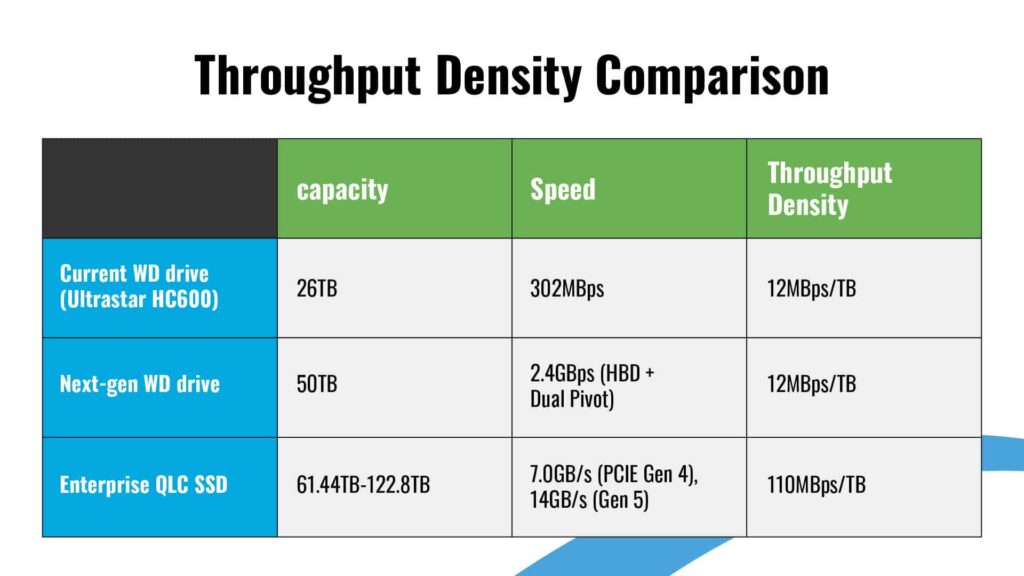
The second reason is that once HDD throughput exceeds certain thresholds, it’s good enough for certain read-intensive AI tasks, such as inference. While SSD will still have a far greater throughput density, this just doesn’t matter that much for such tasks, especially given SSD’s far greater cost.
Finally, increased throughput helps a lot with rebuild times in RAID setups. Low bandwidth can really gum up the works, and a lengthy rebuild process is a window in which other drives can fail.
The bandwidth goal is what differentiates WD from its competitors, but it’s just one piece of the overall puzzle. The firm plans to have 40TB and 44TB drives by the end of this year, followed by 60TB drives in 2028, and 100TB drives in 2029. To get to 100TB, the firm plans to have 14-platter drives. Consistent with previous messaging, Western Digital emphasizes “smooth transitions” to HAMR, possibly a veiled dig at Seagate’s long (15-month) qualification periods for HAMR drives.
Related Reading
Even if HDD maintains its grip on warm storage, flash remains necessary for hot storage applications where high performance is a must. An effective hybrid storage arrangement can give data centers the best of both worlds: flash performance where needed, and cost-saving HDD elsewhere.
The Response
Commentators have been mostly impressed.
Chris Mellor went so far as to claim that this “breaching of the HDD I/O density wall” by Western Digital “completely resets the relationship between disk drives and SSD, removing SSD’s bandwidth superiority, though not their latency advantage.” Recall that Mellor previously cited bandwidth in his 2024 case for SSD replacing HDD. He’s now changed his tune about HDD’s fortunes: he thinks this move will “ensure disk drive storage relevance for decades to come.”
Mellor also expects Seagate and Toshiba to follow if WD is successful. Larry O’Connor, CEO of Other World Computing, concurs, claiming that while WD was the first to announce this bandwidth increase, “all manufacturers have been heading in this direction.”
Analyst Tom Coughlin sounded a more tentative note, pointing out that WD’s higher disk count could translate to a higher bill of materials. The firm is helped, however, by the fact that it is using ePMR for a while longer before transitioning fully to the more expensive HAMR.
Of course, it remains to be seen whether WD’s HAMR rollout will be as smooth as it insists, and whether the firm meets all of its bandwidth milestones. Still, it’s a bold move.
Related Reading
Now that WD and Seagate have both unveiled 40TB+ hard drives, the 50TB milestone is right around the corner.
A Match Made in Heaven? NVMe for HDD
Of course, bandwidth is only useful if your connection allows you to take advantage of it. The problem is that 600MB/s is the upper limit on bandwidth allowed by the SATA III. And that’s the theoretical limit: it is usually less in practice.
This makes a change in interface a matter of priority. In a mid-2025 interview Ahmed Shihab, chief product and engineering officer at WD, said that NVMe for HDD would only become important when HDD bandwidth exceeds that allowed by SATA. “If there’s no need for it, don’t do it.” Well, now the need is there. What are the prospects for NVMe for HDD?
While Seagate’s strategy has been to go all-in on increasing areal density, they’ve also paid attention to bandwidth. For years, the controllers in its Exos platform have contained dedicated PCIe lanes which allow high bandwidth connectivity. Not coincidentally, Seagate has also been a pioneer in NVMe HDD. While HDD is not yet fast enough to take advantage of the transfer speeds that NVMe enables, the hope is that this makes it easier to change the storage mix as needed, and reduces the need for complicated bridges and adapters.
This is an odd state of affairs. Given WD’s push to become the bandwidth king of disk drives, and Seagate’s move towards NVMe HDD, two complementary technologies are in the hands of competing companies. Whichever firm can master both trends at once may be best positioned to lead hard drives into the 2030s and beyond.
Related Reading
NVMe-native HDD makes it possible to integrate HDDs into high-performance data centers by simplifying hardware and firmware layers.
A Promising Strategy
Let’s pull back and look at what this means for the hard drive industry. While it’s too soon to tell, there’s a possibility that this will be a game changer, helping HDD hold its ground in warm tiers of data storage. However, note that WD isn’t relying on bandwidth alone for its cost savings. There will likely be a race between HDD manufacturers to discover which techniques pair together best with high bandwidth to lower TCO.
In other words, even though WD is the first to push in this direction, that doesn’t mean they’ll necessarily keep the lead. This is especially true given the large bill of materials required for its planned 14-platter drives. There are also unknown unknowns. Technology and supply chains are shifting rapidly, and quirks of geopolitics could throw a wrench into any plan.
The HDD bandwidth boost is a promising strategy. As for which OEM can best capitalize on this promise and take the fight to QLC SSD rivals, the jury is still out.
At Horizon Technology, we know all about data center HDD. For practical support with procuring drives, get in touch.