




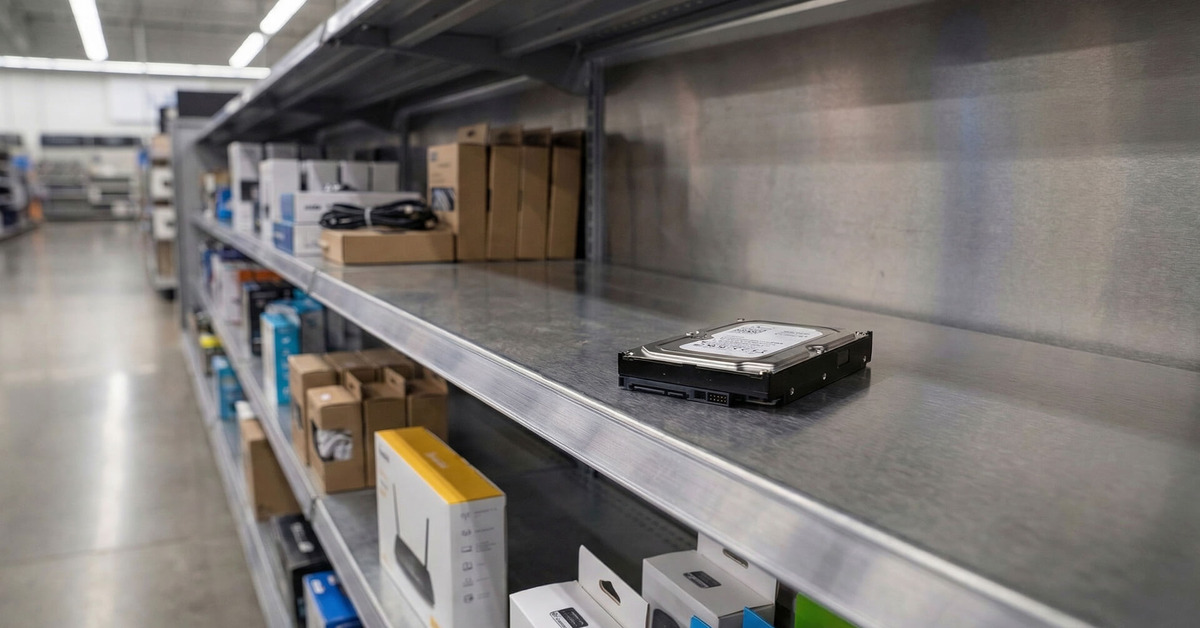
Over the past year, the AI craze has put significant pressure on tech supply chains. When it comes to the long-term effects of this surge, that’s anyone’s guess (not that we haven’t tried). But one thing is clear: the rapid pace of data center construction has led to soaring prices for a wide swath of data center hardware. And this, of course, includes hard drives.
Voracious hyperscale demand means there are fewer hard drives left over for enterprise data centers and consumers. This issue is unlikely to abate anytime soon, due to the difficulty of rapidly expanding production and the industry-wide shift to a build-to-order model.
As shortages push prices higher, every data center manager and IT asset management (ITAM) professional needs to ask how they can lower acquisition costs, including the role that recertified drives — rigorously tested drives that offer near-new performance at a lower cost — can play.
Background: The Everything Shortage
The hard drive shortage isn’t happening in isolation. To understand the current supply crunch and price pressures, it helps to consider how the AI-driven data center construction boom is affecting the broader tech industry.
From Cycle to Surge
The fortunes of tech companies are cyclical. Even the pandemic was no exception: there was depressed demand, followed by storage shortages, followed by a storage glut. But the AI boom may be something different: an epochal shift instead of another turn of the business cycle.
The current demand isn’t entirely surprising. As early as mid-2023, less than five months after the public debut of ChatGPT, TrendForce estimated that OpenAI’s appetite for GPUs might lead to shortages. Supply was calm throughout the rest of that year: there was even a chip glut. This led to what analyst Tom Coughlin characterized as a “severe recession” in 2022-3, followed by “significant recovery” in 2024.
Two years later, things look different. In September 2025, TrendForce reported that demand for AI inference had led to severe nearline HDD shortages. Hyperscalers began facing severe bottlenecks. Other technologies were affected as well. NAND and DRAM prices jumped 15-20% in 4Q2025. Solidigm CRO Paul Palonsky claimed that the industry would face a 3-year NAND chip shortage, and that “demand was grossly under-estimated”. Even lasers, key for high-speed optical interconnects, proved scarce.
Rising Prices
To no one’s surprise, these supply pressures have led to rising prices and sales. The top five SSD brands saw a 28% increase in combined revenue for 3Q2025. By November, NAND wafer shortages resulted in price rises of between 20%-60%. Sandisk, for its part, raised NAND prices 50%.
Despite the shortages, HDD prices have been a bit steadier than flash, with HDD contract prices rising 4% q-o-q towards the end of 2025. This may be changing, however. TechPowerUp reported in January that HDD prices had increased by 46% over the previous four months. This was based on data from the ComputerBase tracker, which indicated that prices have increased anywhere from 23% for Seagate IronWolf Pro NAS HDD to 66% for Toshiba Cloud Scale Capacity MG10F AFA 22TB.
Shifting Demand
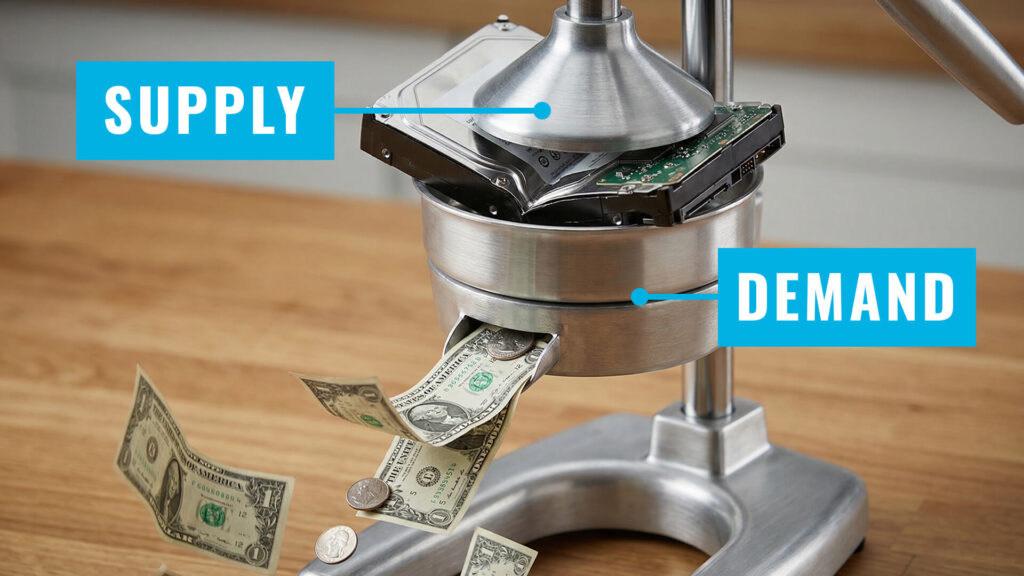
While AI gets the most coverage, it’s not the only force shaping demand for data storage. “Certainly AI is the primary catalyst,” agrees Horizon Technology COO Stephen Buckler. “But let’s not forget the way in which SSD has shaped storage fundamentals and changed the demand footprint. This has led manufacturers to shift from the commodity model to the build-to-order model.”
This shift would be enough on its own to make the supply chain less flexible. But AI pours fuel on the fire. “Between the two events you have a perfect storm reshaping the storage market”, Buckler says.
Analyst Tom Coughlin agrees that these factors are having a significant impact. “It is likely that recent increases in nearline HDD prices are a combination of the longer-term contracts that the HDD companies have established with big HDD consumers to stabilize HDD prices after the last recovery in demand,” Coughlin argues. When combined with customers buying in advance to stay ahead of foreseen supply pressures, this leads to “distortions in the actual demand, driving companies to purchase or try to purchase more than their real short-term need.”
Related Reading
Acquisition costs are just one of the variables that determine the TCO of storage hardware. To minimize costs, you need to account for power consumption, the role of data reduction, and more.
HDD Shortages
The shift to long-term contracts matters, because once those are fulfilled, stragglers are left in the lurch. Late last year, Tom’s Hardware reported that hard drives were already on a two-year backorder. In early February, Western Digital CEO Irving Tan indicated the company was “pretty much sold out” of hard drives for calendar 2026. Shortly after, Seagate announced that its nearline capacity was fully allocated.
While HDD prices are up, the increase isn’t as wild as it is for SSDs and memory.
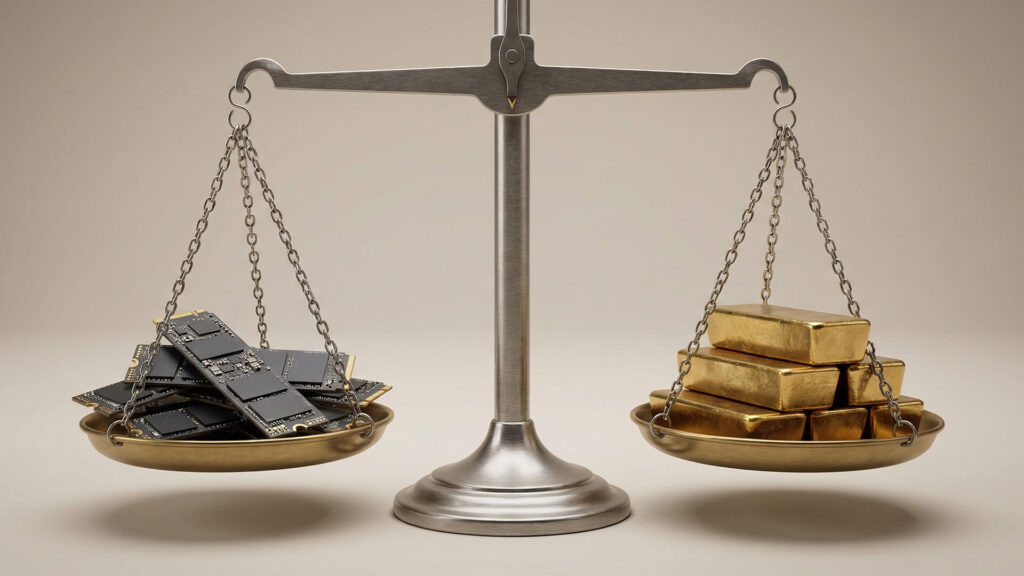
AI storage supplier VDURA, at least, believes that flash prices are rising faster than HDD costs. Nor do HDD and SSD prices operate independently. TrendForce observes how the shortage of HDDs is increasing demand for flash, as companies turn to NAND to fill the gap.
Just what is the ASP (average sales price) of hard drives right now? It’s hard to say. Tom Coughlin has noted that both Seagate and Western Digital have stopped reporting the number of units shipped, reporting only exabytes. This makes it difficult to calculate ASP, adding an element of uncertainty to the pricing situation.
Of course, HDDs and SSDs play well together in a hybrid storage setting. But there’s a contested middle-ground of hot-but-not-too-hot storage for which differing media make competing cases.
Last October, TrendForce reported that NAND suppliers were shifting to high-cap nearline QLC SSDs, since the shift of HDD to HAMR means difficulty scaling production. However, in a recent interview, Larry O’Connor, the CEO of Other World Computing, claimed he had “seen a real shift in balance towards spinning HDD over SSD” with the former being favored over SSD for “general and mid-level data performance requirements”.
The takeaway is that demand for SSD and HDD are connected in a push and pull, as consumers carefully vie for the option with the lowest TCO. Disk delays reduce GPU utilization, driving demand for SSDs to tackle a warmer tier of data. But since NAND fabs are difficult and costly to construct (they need clean rooms to prevent particulates from getting into the devices), HDD is very much still in play.
Related Reading
In times of shortage, a little flexibility goes a long way. Composable infrastructure allows data centers to more easily mix and match different storage media, allowing them to adapt quickly to changing hardware availability.
How Factory Recertified Drives Can Help
With both HDDs and SSDs in short supply, which should one opt for? There’s one clear difference here to keep in mind: getting hard drive units hot off the assembly line isn’t the only option, as the resale market for HDDs is larger and more established than the market for used SSDs.
This is even true where state-of-the-art high-capacity drives are concerned. Used doesn’t mean worn out. Factory recertified (FR) drives are a case-in-point. These are drives that have seen little or no use, which are sanitized and re-tested by the OEMs. For example, if a drive is used for demonstration purposes, or was part of a returned batch, it can be rigorously tested and recertified before being resold at a discount.
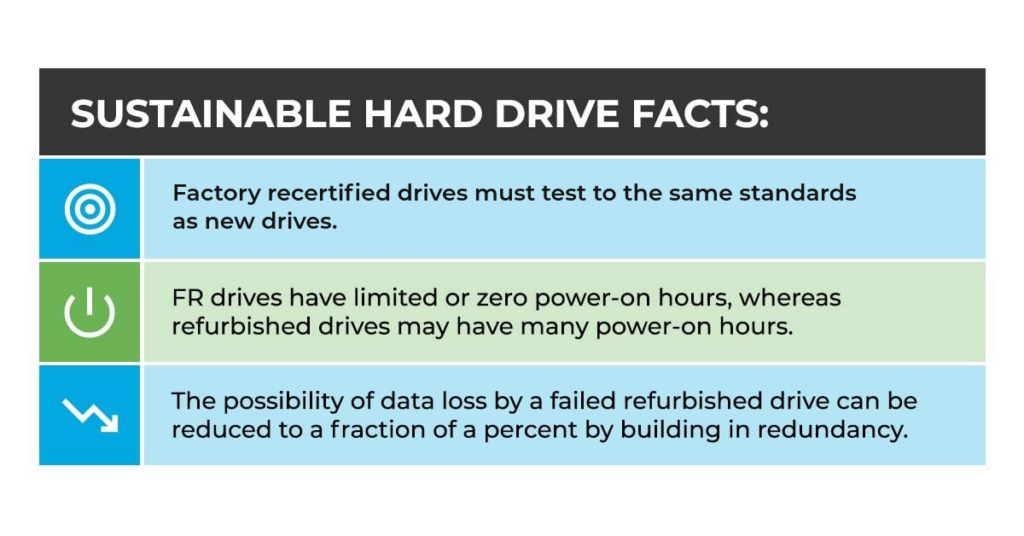
For years, groups like the Circular Drive Initiative have been pushing factory recertified drives as an affordable, secure, and more sustainable option. Now, shortages are pushing many consumers in this direction.
“Absolutely, end users who would not consider FR drives are now open to the option” explained Buckler. And he expects the trend to continue. “We expect to see adoption increase throughout 2026.”
Of course, increased demand for hard drives is correlated with price increases for reused server hardware more generally. According to E-Scrap News, average server resale values are up 328% at legacy Cascade facilities, and 417% at Sage Sustainable Electronics. But this figure isn’t for HDD specifically, and factory recertified drives are still cheaper than ordinary hard drives.
The Importance of Certification
The “certified” in “recertified” is important. When purchasing recertified drives, it’s important to purchase from a reputable seller, since bad actors have been known to fraudulently sell heavily used hard drives as “new”. A factory recertified drive should come with an official OEM (original equipment manufacturer) label.
Buying from an official reseller is also an important part of strategic procurement. For security reasons, OEMs like Seagate emphasize the importance of working with authorized distributors. Since these distributors are in close contact with OEMs, they often have a better sense of what specific models of recertified drives will be available, and when. This is particularly useful at a time when long-term contracts make it difficult for smaller buyers to predict what will appear on the resale market.
Related Reading
From monitoring prices, to lifecycle strategy, to working with authorized distributors, here’s our guide for how to effectively procure factory recertified drives.
Navigating Procurement Strategies for Factory Recertified Drives
Where Is This All Going?
The uncertainty surrounding AI can make it difficult to plan for your data center’s storage needs. Demand for data center hardware, including storage, is unlikely to abate any time soon. Just what will be available and when? It’s hard to say.
Factory recertified drives provide an additional supply stream during critical procurement windows. AI drives uncertainty, but uncertainty is nothing new, and the built-to-order model will likely stick around even if AI demand wanes. By leveraging the knowledge of authorized distributors, data center managers can get the inside scoop on what recertified drives will be available.
Of course, not everyone uses recertified drives. “There is not a universal acceptance, not yet,” says Buckler. Still, it pays to plan ahead, and the recent shortages are a case-in-point. “The increase in prices caught many integrators by surprise,” he continues. “It was those that recognized what was happening and acted, securing stock, that positioned themselves for success in this very fluid and uncertain market.”
While much has changed, this much hasn’t: it pays to plan ahead.
At Horizon, we draw on almost 30 years’ experience working directly with OEMs to distribute factory recertified drives. Get in touch to purchase affordable inventory for your data storage needs.