




While 2030 may feel distant in the world of technology, the speed of change makes it tomorrow’s problem. The AI explosion now underway is driving a seismic shift in the tech industry, its jolts felt in capital expenditure, capacity, and energy consumption.
Data centers hold the key to the digital services we rely on, and will continue to form the silent backbone of this radical overhaul. And hard disk drives, far from fading away, are evolving into capacity giants poised to play a central role in the data centers for the foreseeable future.
What will these future setups look like? How much energy will they consume? And what storage mix will they use? Here are some numbers, roadmaps and predictions that point to the answer.
Predictions: Capacity, Power, Pay-off
First, let’s look at some headline numbers to understand the scale of what’s coming. By 2030, hyperscale data center capacity is set to nearly triple. Both Synergy and McKinsey project the same steep growth driven by AI demand.
Scaling Up
At the moment, overall capacity is rapidly shifting away from traditional data center setups to hyperscale operators. Synergy estimates that, by the end of the decade, hyperscalers will control 61% of total data center capacity, up from 44% today. By 2030, just 22% capacity will sit within traditional on-prem data centers, with the rest residing in non-hyperscale colocation facilities.
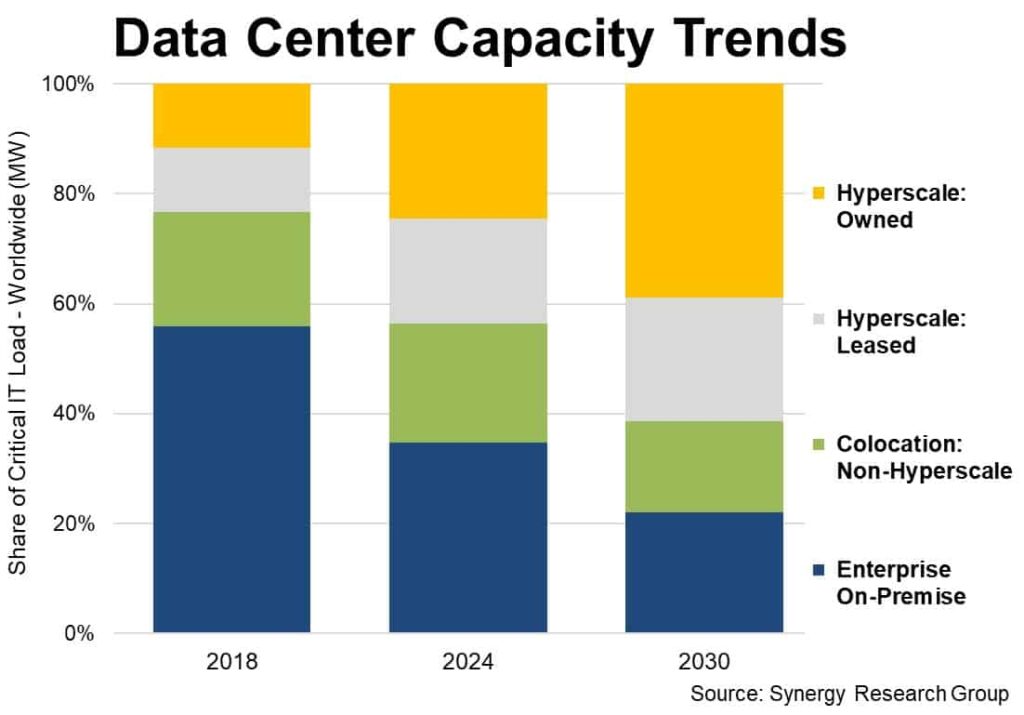
In a separate update, Synergy predicted that hyperscale data center capacity would triple by 2030. And all that capacity won’t come cheap. According to McKinsey, data center build-out will need a $5.2 trillion investment by 2030 to meet the global demand.
Power Bottleneck
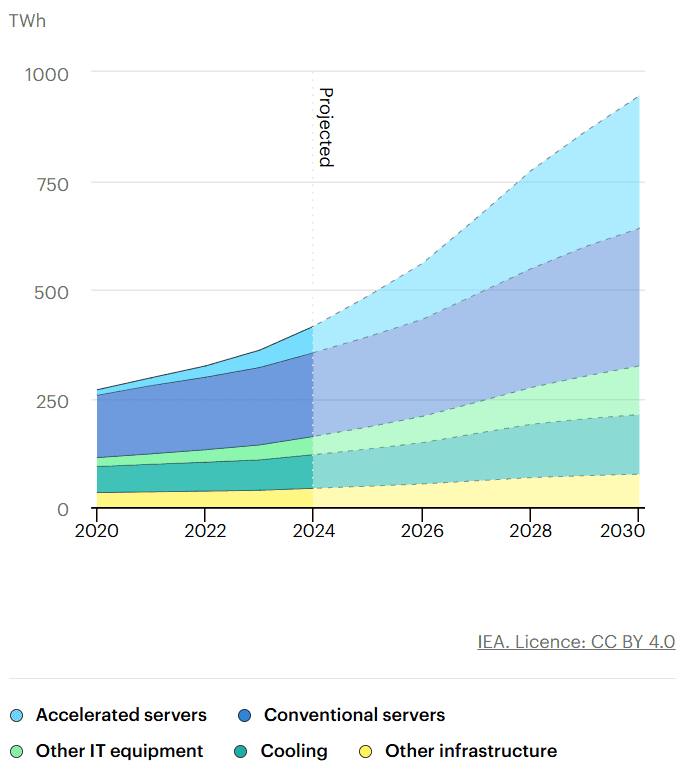
This kind of growth doesn’t come without a fight over electrons. Goldman Sachs sees the global data center power requirement rising as much as 165% by 2030, compared to 2023. The IEA’s forecast is even more stark. It estimates that data center energy usage will grow four times faster than all other sectors, more than doubling in six years from 415 TWh in 2024 to 945 TWh in 2030.
In the U.S., Schneider Electric reports that the electrical grid capacity can meet the expected demand through 2030, but with an increasingly thin safety margin and risk of local shortfalls.
Is the AI Investment Worth It?
All of which raises the question: Is the investment worth it? The global impact estimates do seem to justify the CapEx. IDC forecasts that AI solutions and services alone will yield a “global cumulative impact” of $22.3 trillion by 2030, which is about 3.7% of world GDP. Synergy, in line with the consistent growth shown by the hyperscalers, also thinks the investment is worthwhile.
However, it’s also worth noting that these projections might look quite different depending on the future of the AI industry. According to J.P. Morgan, the sector needs to generate $650 billion in annual revenue for a 10% return on investments made through 2030. While Synergy thinks companies can afford the data center construction CapEx, others call the AI craze a bubble waiting to pop.
Related Reading
While much about the future storage mix is uncertain, we believe that HDD will remain a central player into the next decade. Here’s why.
HDD Frontier: Bit-Patterned Media
Of course, all of this AI infrastructure will need data storage to support it. And that’s where the race to expand areal density kicks in.
Heated Dot Magnetic Recording (HDMR), also known as Patterned Heated Dot Media, is the next leap from Heat Assisted Magnetic Recording (HAMR). HAMR media uses magnetic coating with grains of random size and shape. HDMR builds on this by using advanced lithography and etching techniques to create special magnetic media prepared with a precise pattern of very minute isolated magnetic grains.
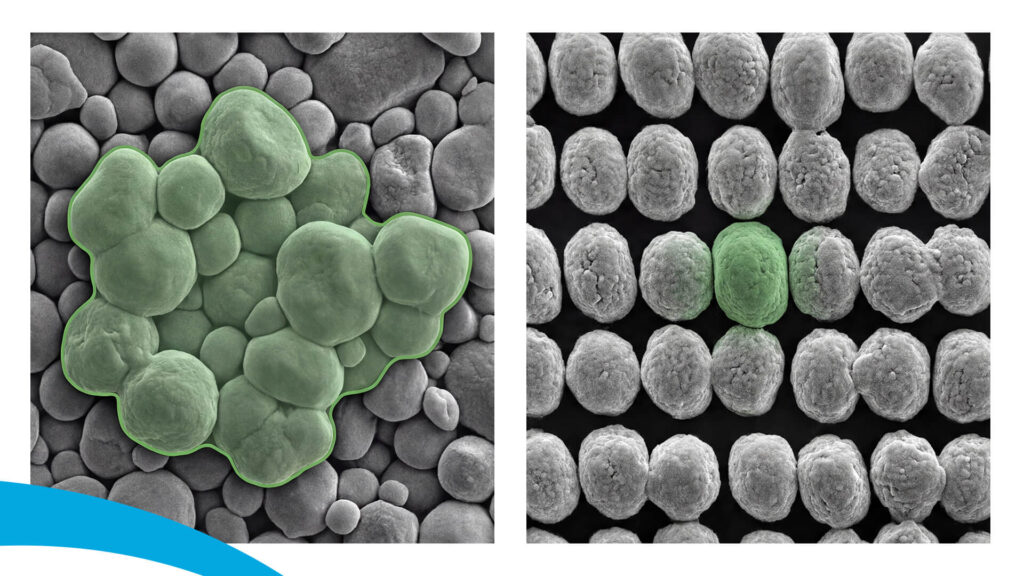
Each pre-patterned, uniform “island” on the disk represents one bit. Because each physically separated bit is designed to be thermally stable, HDMR overcomes the limitations of noise and interference found in current HAMR media. The result is significantly higher areal density, enabling more data to be packed per square inch.
The payoff is obvious, but also comes with material and process challenges. Given the technological complexities, it might take a while for HDMR to take off. A 2023 IEEE roadmap stated that HDMR could hit an areal density of 10 Tb/in^2 within 15 years. The same report predicted that the Big 3 manufacturers would fully adopt HDMR only by 2037.
Related Reading
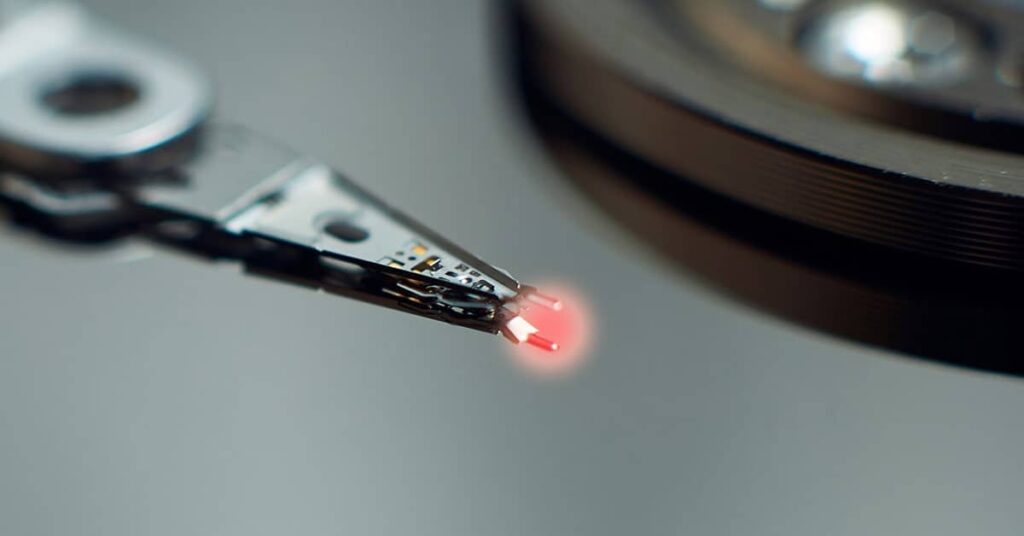
HDMR is quite a ways off, but HAMR is already here. During writes, HAMR technology uses a laser to temporarily heat patches of recording media, temporarily lowering its magnetic ‘hardness’.
Big On Capacity: 100TB HDDs
The path to 100 TB is far from simple. HDDs face two main long-term hurdles: supply shortages and keeping HAMR prices low. Clear those hurdles, and high-cap HDDs with their $/TB edge over SSDs will continue to dominate cold and nearline storage for the foreseeable future.
Analyst Tom Coughlin believes that the future is bright for HDD. By 2030, he predicts that HDD capacity will be over 6.5EB. He thinks dual-actuators will become standard in high-cap hard drives, and that over 90% of shipped HDD units will be for nearline applications. And crucially, Coughlin believes the cost difference between HDD and SSD will remain >4x through at least 2030.
Western Digital
WD is all-in for 100 TB HAMR drives and hopes to reach the milestone by the end of the decade. According to the firm’s timeline, by 2030 HAMR technology will allow non-SMR drives to hit 80 TB and UltraSMR drives to reach 100 TB. WD claims that HAMR technology, when paired with other latest technologies like OptiNAND and UltraSMR, will enable HDD to maintain a 6X lower $/TB advantage over SSD through 2030.
As for HDMR drives, these already sit on WD’s official timeline, as announced at a recent investor day session. Projected to arrive by 2030, these drives will carry HDD capacity beyond 100 TB.
Seagate
Seagate is also on target. Its chief commercial officer says the firm’s goal is to have 100 TB HDDs on the market by 2030. The company is already shipping 30TB+ HAMR HDDs with plans to move up to 40 TB+ in 2026 and 50 TB+ by 2027. With a 10TB-per-disk proof-of-concept slated for 2026-27, Seagate could hit the 100 TB+ HDD mark by early 2030.
Timeline Reliability
But how reliable are the timelines? Sunny Grimm at Tom’s Hardware flagged a mismatch with Seagate’s previous timeline promises. The firm originally planned for 50 TB HDDs by 2026, but updated to 40TB+(Mosaic 4+) HDD by 2026 and 50TB+ HDD(Mosaic 5+) by 2028. The new push shows Seagate is trying to get back on track, but Grimm advises caution in believing the “100 TB+ by 2030 claim” at face value.
Related Reading
Which of the Big Three HDD manufacturers will be the first to debut a 50TB drive? Here’s our summary of the strategies Seagate, Western Digital, and Toshiba are pursuing in pursuit of the milestone.
The Data Center Storage Mix
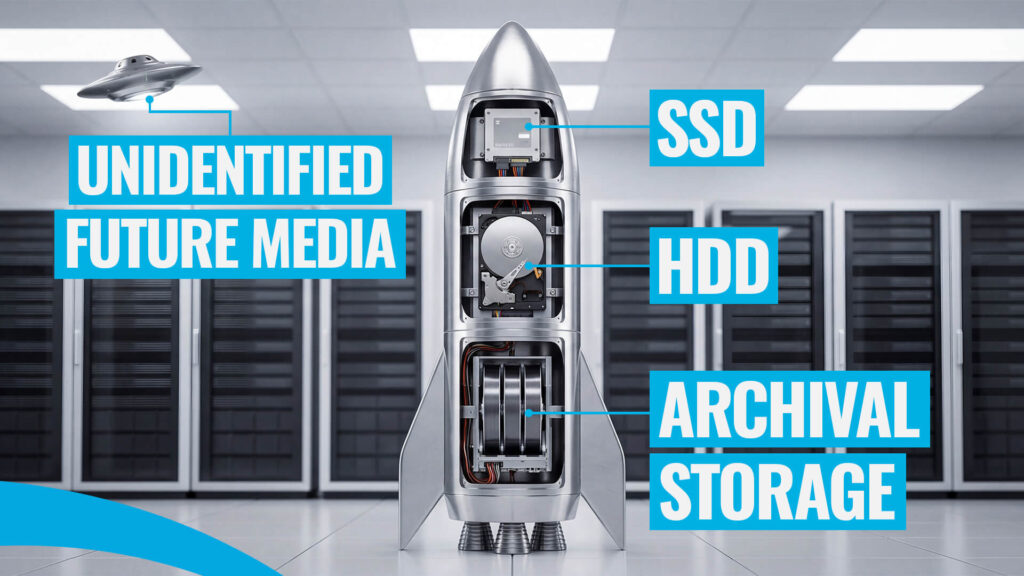
To understand the role of HDD in 2030, you need to understand how it fits into the overall storage mix. This will likely remain tiered into hot, cold, and archival storage, but new tech like optical storage and QLC may play a larger role.
QLC SSD
As AI-fueled shortages stretch nearline HDD wait times to two years, QLC SSDs are stepping up to fill in the gap. So much so that by 2027, analysts predict enterprise QLC SSDs may surpass TLC SSDs in popularity.
Compared to MLC and TLC SSDs, QLC SSDs allow denser storage at a lower cost but with a noticeable hit to endurance and performance. Against nearline HDDs, QLC SSDs still can’t compete in costs, but deliver faster speeds, making it more appropriate for low access (warm) storage.
Related Reading
It’s worth remembering that the rivalry between SSDs and HDDs isn’t a zero sum game. Hybrid storage architectures aim to provide the best of both worlds, combining flash performance as needed and low $/TB HDD for mass storage.
Optical Storage
Storage architects have no shortage of ideas and demos. But which sci fi futures could, and will, become reality? Sure, DNA data storage probably won’t replace magnetic tape anytime soon. However, optical storage has a chance of taking the storage world by storm.
By 2030, a new generation of optical storage may begin to play an important role in archival storage. Details vary by company, so let’s focus on Optera, whose white paper is authored by analyst Tom Coughlin. Based on “spectral-hole burning,” this technology encodes data using recording media’s optical absorption/emission characteristics, creating what are known as “spectral holes.” The optical media is made of a mixture of nano-particles. A high-energy laser is used during the writing stage, while a low-energy laser is used to read back the written spectral holes.
With a shelf life exceeding 100 years, costs could drop as low as $0.10/TB for write-once discs, putting optical storage in direct competition to tape and spun-down HDD. Analyst Tom Coughlin projects 1 PB optical cartridges in the market by 2030, outpacing LTO Gen 14 – 567 TB capacity cartridges due in the same timeframe.
Of course, it might not be Optera. It could instead be a rival version of optical storage such as Cerabyte, which also predicts costs below $1/TB by 2030. It could also be some other form of storage waiting in the wings for its big moment. Part of the fun of long-term predictions are the unknown unknowns. Any honest prognosticator must acknowledge that the future may be heavily shaped by technological shifts or shortages we cannot anticipate.
Up And Away
By the end of the decade, data centers will undergo a major overhaul in size, power draw and costs.
While it appears SSDs will continue to dominate the hot tier without serious challenges, HDDs, with their low $/TB advantage and 100 TB on the horizon, will maintain their grip on cold storage needs. The archival and warm storage tiers aren’t without their tug of war. While optical storage tech is on its way to leapfrog tapes for the archival storage dollars, QLC SSD is surging as a middle ground between SSDs and HDDs.
The storage landscape is shifting faster than at any point in the last few decades. Companies that fail to map the complexities of production and technology will be paying tomorrow’s price for yesterday’s tech.
Get in touch to see how Horizon Technology can help you procure affordable storage which meets the needs of your data center.