





For systems integrators, planning for storage is not always as easy as it should be. The reasons for this may not immediately seem clear. A hard drive can be in stock, competitively priced, and technically suitable on paper—yet still be the wrong purchase.
That is because an SI is rarely buying storage in isolation. Instead, it is buying against a customer commitment: a quoted configuration, a deployment schedule, and, oftentimes, the natural assumption that the system can still be supported after installation.
Customers, in turn, have clear expectations of what they’re getting. A delayed batch, a firmware or sector-format mismatch, or an unavailable replacement is not something the integrator can simply ignore and hope for the best.
A Systems Integrator Is Buying a Customer Outcome
For the system integrator, storage procurement sits inside a larger delivery commitment. The integrator is responsible not just for buying the hardware but for making sure the system works as promised.
An enterprise HDD supplier should therefore be judged on more than price and in-stock availability. More critical is whether supply is predictable, the correct drive can be qualified for the target system, and replacements can be supported efficiently over throughout the system’s lifecycle.
That makes supplier performance part of project performance. Price and availability matter, but the larger question is whether the hardware can be delivered and supported as promised.
Availability Has to Be Predictable
Spot availability is not the same as predictable availability. Spot availability answers the immediate question: can I buy this product now? Predictable availability asks whether the SI can build a customer delivery plan around that supply.
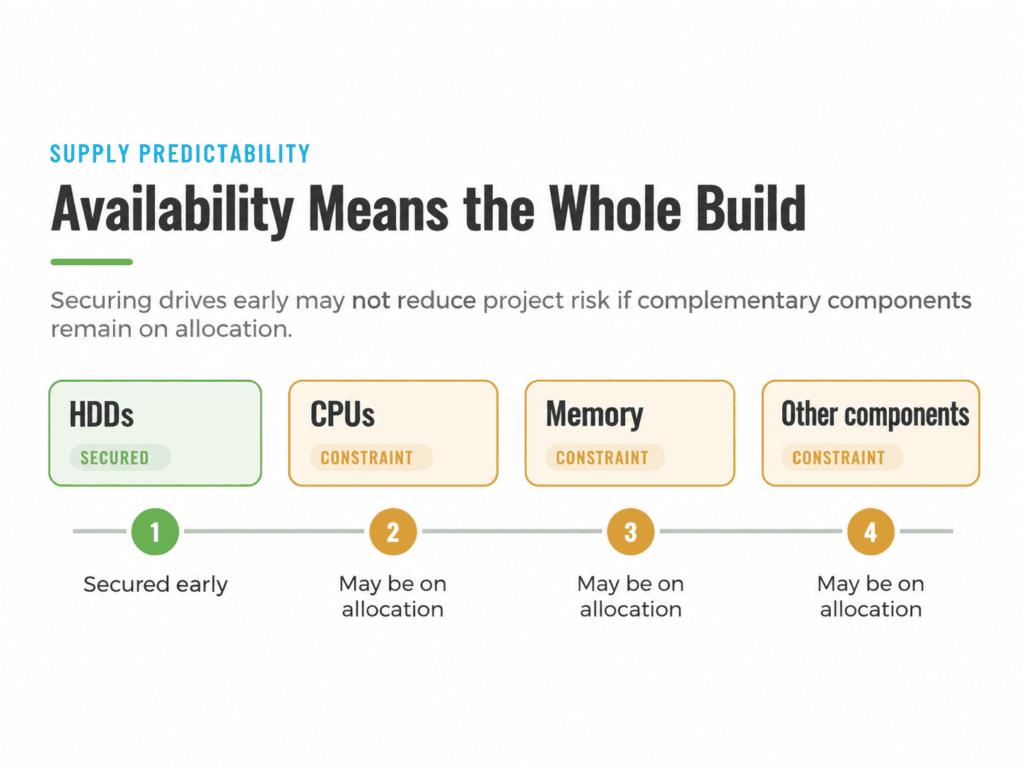
That makes advance buying less straightforward than it can appear. Storage is only one constraint inside the build, so securing drives early may not reduce project risk if complementary components remain on allocation.
Supplier evaluation must therefore consider the full build, not simply the HDD line item. Can the supplier support the same configuration across the project window, distinguish one-time inventory from repeatable supply, and communicate changes early enough for the SI to adjust?
“Most systems integrators still buy against a specific project rather than stocking ahead for anticipated demand. Even when it would make sense to secure drives early, the HDD is only one part of the system—CPUs, memory and other components may also be on allocation. You have to look at availability across the whole build.”
— Stephen Buckler, Horizon Technology COO
The Right Drive Matters
Enterprise storage systems are built around qualified combinations, not capacity and interface alone.
Two apparently equivalent 16TB SAS drives are not necessarily interchangeable in production. Take Dell‘s advice that in certain MD arrays a drive sharing the same underlying manufacturer model may still fail to function without the required Dell part number and firmware. NetApp likewise recommends keeping its Disk Qualification Package current so systems recognize qualified drives and current firmware requirements.
Start With the Actual Requirement
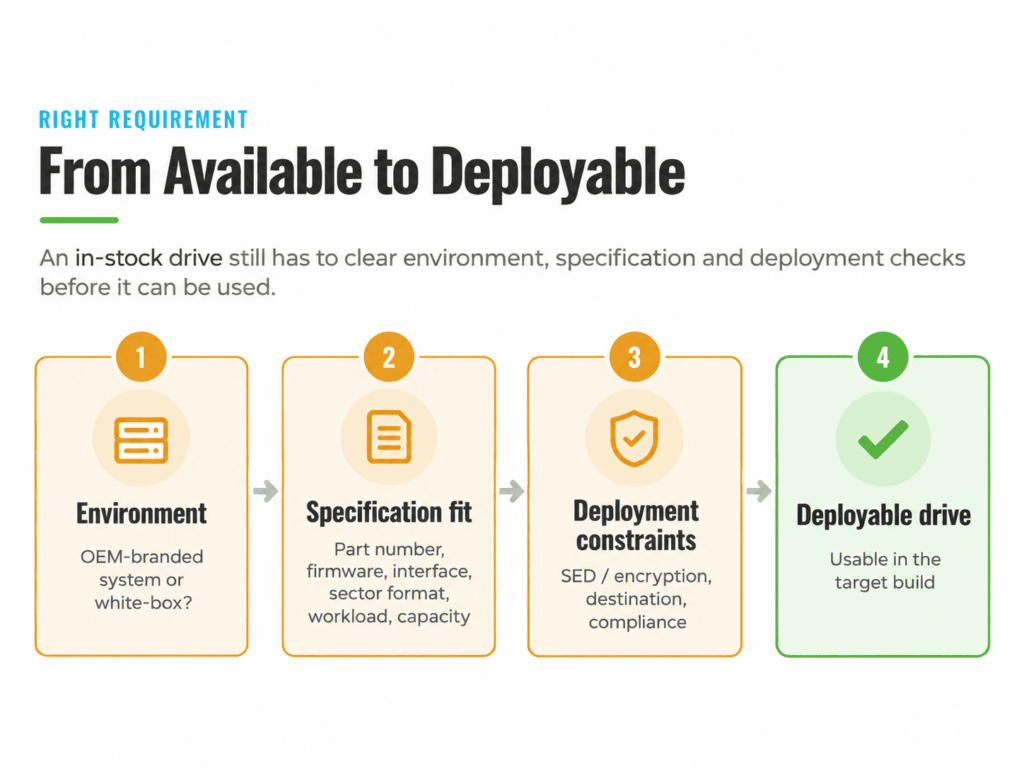
For the integrator, the supplier question begins one step earlier: what constraints actually define the requirement? The supplier can only reduce uncertainty once the buyer has made those constraints clear.
An exact part number helps settle the question. Where the requirement is more flexible, firmware compatibility, workload and deployment context have to be understood before the supplier can identify a genuinely usable option. Capacity requirements also matter because right-sizing the drive affects TCO.
“We’re only as good as the information we’re given. The first thing we need to understand is where the drive is going: is it an OEM system that requires specific firmware, or a white-box environment with more flexibility? From there, part number, capacity, interface, sector size, workload and other requirements determine what is actually usable.”
— Stephen Buckler
Move Uncertainty Upstream
A discrepancy found in staging is inconvenient; the same discrepancy found after installation can trigger field work and another deployment cycle. Mature integration processes aim to discover problems before equipment reaches the customer.
While an HDD supplier cannot replace the SI’s qualification process, it can make that process easier to execute. Clear identification of what is shipping, consistency across a batch and early warning of substitutions all move uncertainty upstream, where it is typically cheaper to resolve.
When evaluating HDD suppliers, consider how easy the supplier makes it to find a problem before the customer does.
What Happens After a Drive Fails?
Supplier evaluation should continue after shipment because even a properly qualified enterprise drive can fail. The useful distinction is between reliability (how the hardware performs) and recoverability (how quickly the customer can return to the intended state when the hardware does not perform as expected).
For an SI, that makes the failure path an intrinsic part of supplier performance. A workable RMA process should provide a clear escalation route, a realistic replacement timeline, and confidence that the replacement will match the deployed configuration. If the original part is no longer readily available, your supplier should be able to explain the implications of the alternative rather than simply ship whatever is closest to your original spec.
A warranty that confirms a failed drive can be returned may satisfy a contract. But does it solve the operational problem? The cheapest purchase becomes less attractive if recovery from failure is prolonged or uncertain.
The Configuration Has to Survive Its Lifecycle
The storage platform may outlive the easy availability of the drive originally installed in it.
When an exact part number disappears, the question is not simply which other drive has the same capacity. It is whether the alternative preserves the assumptions that made the original configuration work. That may require another round of qualification, a firmware change or a decision that the surrounding platform has reached a more consequential refresh point.
Dell has documented this problem in PS Series arrays where newer replacement drives moved to a different sector format; supporting a mix of existing and replacement formats required an appropriate array firmware level. While this example is platform-specific, the broader problem is common: replacement hardware can change while the system around it remains in production.
A supplier that understands lifecycle continuity will help you establish what has changed before suggesting what comes next. That is especially important when your customer expects an installed system to remain expandable and supportable long after the original purchase.
Supplier Requirements Are Global, but Their Weighting Is Not
The fundamentals of supplier evaluation travel well because the SI still has to deliver the system it promised. What changes from market to market is the buying environment around that obligation, particularly where regulation and infrastructure policy shape who can supply and support the deployment.
Same Drive, Different Buying Environment
Take the European Union (E.U.). The underlying drive requirement is not materially different between European and U.S. integrators. What changes more noticeably is how the E.U. market buys and supports that infrastructure.
Data-sovereignty requirements, such as GDPR, may favor a more regionalized purchasing and support model, with more local players serving regional deployments. That can give supply-chain provenance greater weight in the commercial context even when the underlying HDD specification looks familiar.
The European Commission’s 2026 Cloud Sovereignty Framework illustrates the point. It asks cloud providers to demonstrate who controls the service and the supply chain, not simply whether the technology performs. That does not turn an HDD purchase into a sovereignty assessment, but it helps explain why regional purchasing and support structures can matter in Europe.
The practical lesson is not to assume that the same supplier model fits every customer. The drive may be the same, but the commercial and regulatory environment around it may not be.
How to Evaluate an Enterprise HDD Supplier: Key Questions
By the time an SI reaches supplier selection, six questions can expose much of the hidden risk:
| STAGE | QUESTION |
| Specification | Can the supplier tell us exactly what we will receive? |
| Supply | Can availability be planned across the project window? |
| Qualification | Can we validate the product before deployment? |
| Change | What happens if the specified part number becomes unavailable? |
| Failure | What happens when deployed hardware needs replacing? |
| Lifecycle | Can the configuration still be supported when the customer expands or refreshes? |
These questions help clarify what price is actually buying. A lower-cost drive is valuable when it can be deployed and supported without extra work. If it introduces requalification, deployment delays or support burden, the saving may be illusory.
Find the Right Supplier
The underlying issue is variance: how much uncertainty the SI has to absorb between the configuration it promised and the system it can actually deliver and support.
The less variation there is in supply, specification and replacement, the easier it becomes to deliver a repeatable customer outcome. Price and availability are where enterprise HDD procurement often begins, but they should rarely be where it ends.
Ready to Talk Storage?
When a storage project depends on exact configurations and dependable supply over time, Horizon can help systems integrators assess enterprise HDD sourcing options against real deployment requirements.