




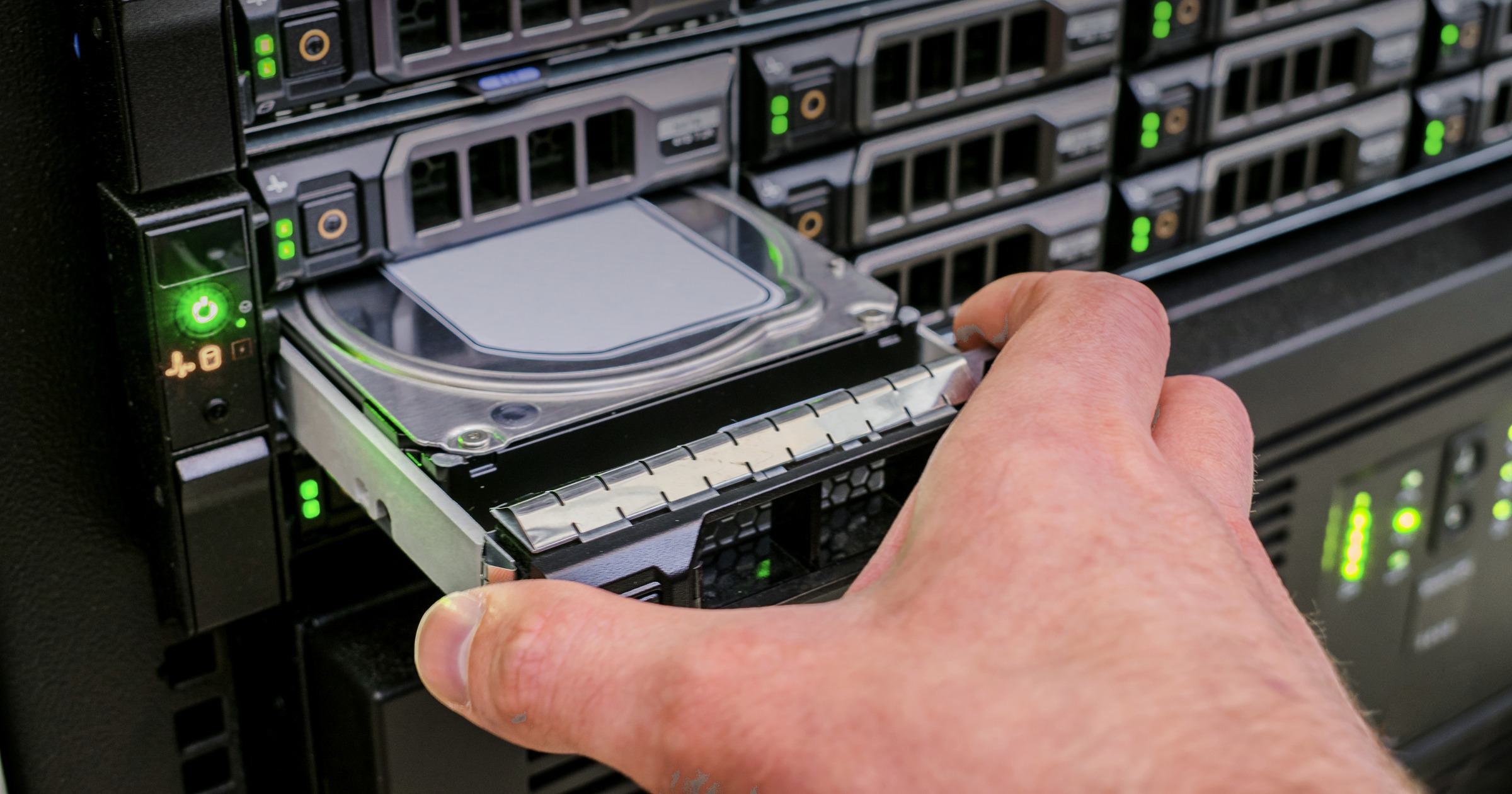
Hot-swapping a hard drive sounds like one of the simpler jobs in enterprise storage. Pull the failed drive. Slide in the replacement. Wait for the system to recognize it, rebuild around it, and move on.
In a fully qualified storage environment, that simplicity is real because a lot of work has already happened upstream. The drive model, firmware revision, controller, enclosure, backplane, and management stack have been tested as a validated combination. The buyer may never see that qualification work, but they benefit from it every time a replacement drive behaves exactly as expected.
When Hot-Swap Compatibility Becomes a Qualification Problem
Mixed-vendor storage does not always offer that comfort. A drive can fit the bay and spin up normally while still behaving in ways the controller or enclosure does not expect. It may identify slowly, present an unexpected sector format, or carry firmware customized for another OEM system.
That is where hot-swap compatibility becomes a more serious procurement question. For systems integrators sourcing drives from the secondary market, the issue is not simply whether the system can see the drive but whether that drive has been qualified for the controller, enclosure, firmware stack, and operating conditions where it will actually be used.
The deeper issue is interoperability: whether drives with different histories, firmware, sector formats, and recording technologies can behave predictably inside the same storage environment.
What Qualification Adds to Compatibility
Drive qualification means confirming that a specific drive will work reliably in a specific storage environment. It is more precise than asking whether the drive is generally compatible with a given interface or capacity class.
The distinction comes down to three related questions:
- Compatibility: Can this drive work in this controller or enclosure?
- Interoperability: Can drives from different suppliers work together predictably in the same system?
- Qualification: Has this exact combination of model number, firmware revision, sector format, recording technology, and system environment been tested closely enough to trust in production?
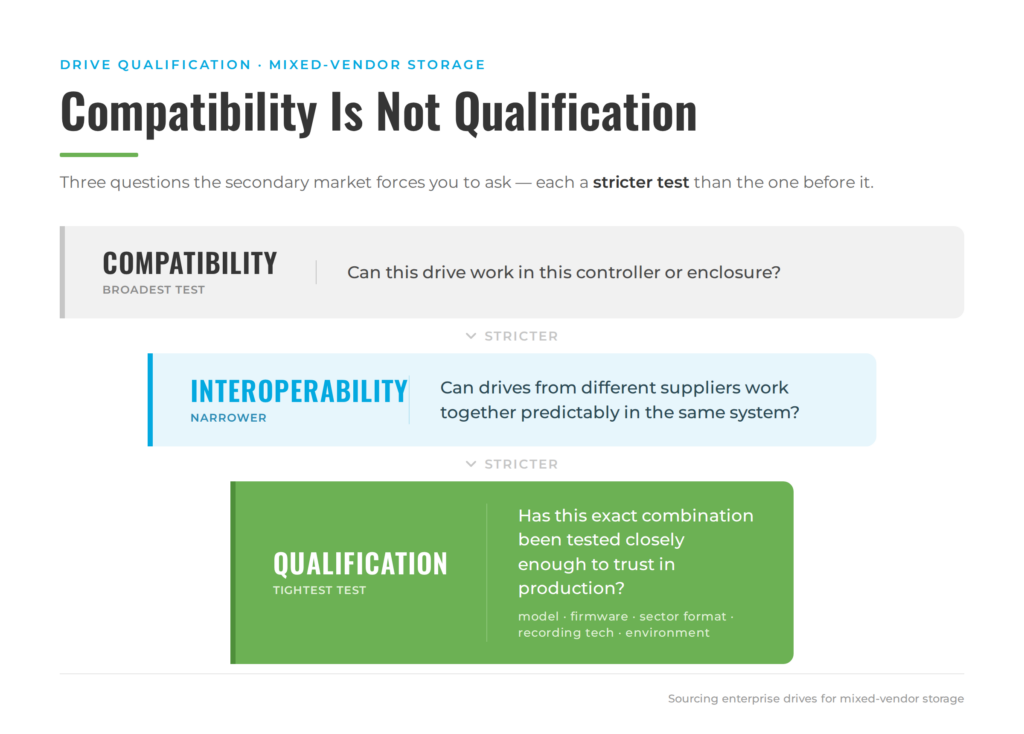
That distinction matters because enterprise storage is built around tested configurations, not just compatible parts.
How Secondary-Market Drives Shift the Qualification Burden
New drives typically arrive with documentation behind them: OEM certified drive lists, controller compatibility tables, vendor-approved firmware revisions, and known enclosure pairings.
Those documents do not make deployment risk disappear, but they reduce uncertainty. They tell the buyer that someone has tested the drive in a defined configuration and found it acceptable for that environment.
Secondary-market sourcing changes the equation. Drives may be standard manufacturer models, OEM-customized variants, factory recertified units, or processed pulls from a previous system. They may have the same advertised capacity and interface but differ in firmware behavior, sector format, error recovery settings, or reporting characteristics.
“With new inventory, buyers are often relying on an OEM-approved path,” says Stephen Buckler, COO of Horizon Technology. “With secondary-market drives, you have to be more deliberate. You need to know the model, the firmware, the format, and whether the drive actually fits the system it is going into.”
The practical question is not simply, “Will this drive fit?” It is, “Will this drive behave correctly in this controller, in this enclosure, with this firmware stack, under the conditions where it will actually be used?”
Hot-Swap and Backplane Behavior
At the simplest level, hot-swap support means a component can be replaced or added while the system remains powered and operational.
A successful hot-swap event usually follows a predictable sequence. The drive is inserted into the bay. The backplane and expander detect the device. The controller identifies the drive and decides whether it can be accepted into the system. From there, the storage software begins the expected workflow: adding the drive to a pool, provisioning it as a spare, or starting a rebuild after replacement.
When every component has been qualified together, that sequence can feel routine. In mixed-vendor environments, each step can become a point of friction.
Where Hot-Swap Events Can Break Down
One drive may take longer than expected to identify after insertion. Another may not respond cleanly to a physical-layer reset. An expander may handle one supplier’s drive behavior without issue but become unstable with another.
LED behavior can also vary, which matters when an operator is relying on enclosure indicators to identify failed, rebuilding, or ready drives. Surprise-removal behavior is another test point: a system may tolerate planned replacement but react poorly when a drive disappears unexpectedly.
These are not always hard failures. The controller may accept the drive but rebuild slowly, report it inconsistently, or log errors during discovery. The result is a system that technically sees the drive but has not necessarily qualified it for stable hot-swap use.
Why Bench Testing Is Not Enough
A drive that spins up, passes a short diagnostic, and reads normally on a test bench has not necessarily been qualified for hot-swap use in a production enclosure. The more relevant test is the actual controller and backplane combination where the drive will be deployed.
For systems integrators, hot-swap testing should include insertion, removal, identification, LED status behavior, rebuild behavior, and surprise-removal handling. The goal is not only to confirm that the drive works but to confirm that the system remains stable while the drive enters and exits service.
Sector Formatting: 512n, 512e, and 4Kn
Sector formatting is one of the easiest qualification details to miss because it is not obvious from the outside of the drive. Two drives may have the same capacity and interface but present storage to the host in different ways.
The Same Drive Class Can Present Storage Differently
The three common formats are 512n, 512e, and 4Kn. A 512n drive uses native 512-byte sectors. A 512e drive uses 4K physical sectors while emulating 512-byte logical sectors for compatibility with older systems. A 4Kn drive uses native 4K sectors at both the physical and logical level.
This distinction matters because storage systems are often built around assumptions. An older controller, operating system, or existing array may expect a particular logical sector size. Microsoft’s support guidance for 4K sector hard drives notes that operating systems, applications, and hardware devices may support sector formats differently.
If a replacement drive presents a different format, the system may reject it, behave unpredictably, or introduce performance problems. In some cases, the issue may not appear at insertion but surface later during provisioning, rebuilds, or sustained workloads.
Reformatting Is Not Always a Safe Assumption
Reformatting can sometimes solve the problem, but not always. Seagate’s FastFormat technology is one example of a manufacturer-supported approach that allows certain SAS drives to convert between 512e and 4Kn host block sizes. But that capability should not be assumed across all enterprise drives and firmware variants.
Some drives may be locked to a format because of OEM provisioning or prior configuration. Even when reformatting is possible, it needs to be confirmed before the drive enters a production pool, not discovered during a replacement event.
For mixed-vendor sourcing, model number alone may not tell the full story. The same general capacity class can include drives with different sector formats, and similar-looking drives may have been prepared for different systems.
That makes sector verification a basic intake step. Before deployment, integrators should document the drive’s logical and physical sector size, confirm whether reformatting is available, and test the drive in the environment where it will be used.
SMR: The Qualification Trap
Shingled magnetic recording, or SMR, is a useful example of why drive qualification cannot rely only on model matching or a short bench test. An SMR drive may look like a conventional replacement from the outside, but its recording behavior can affect interoperability in RAID, NAS, and rebuild-heavy environments.
When Recording Technology Became a Disclosure Issue
The issue came into sharp focus in 2020, when reporting revealed that some hard drives using SMR had shipped without clear disclosure. Western Digital’s WD Red line became the focal point because those drives were marketed for NAS use, where sustained writes, rebuilds, and multi-drive behavior are central to the use case. Seagate and Toshiba were also found to have shipped SMR drives in some product lines without clear disclosure, but the WD Red case carried particular weight because of its RAID and NAS context.
The controversy later became a legal and disclosure issue. In Malone v. Western Digital, a class action filed in 2020 and settled in December 2021, Western Digital agreed to a $5.7 million settlement tied to certain WD Red SMR models. The affected models included 2TB, 3TB, 4TB, and 6TB EFAX drives. As part of the settlement, Western Digital agreed to provide prominent SMR disclosure on packaging for four years.
For secondary-market buyers, the important point is not the litigation itself. It is that recording technology became a qualification variable. A drive’s interface, capacity, and brand family were not enough to tell buyers whether it was suitable for a given NAS or RAID environment.
The Secondary-Market Risk Did Not End With the Settlement
That lesson has become more relevant as drives from that era continue to circulate. The settlement’s four-year packaging disclosure requirement has now run its course, while older drives remain present in resale channels. For systems integrators, the point is practical: retail-era disclosure, product labeling, or surface-level model familiarity may not be enough to answer the qualification question.
Why SMR Belongs in the Qualification Process
The lesson is not simply to avoid SMR. SMR can have legitimate uses when the workload, system design, and expectations fit the technology. The lesson, instead, is that recording technology, product history, firmware behavior, and known failure patterns all belong in the qualification process.
“A clean health report is not the same thing as a qualified drive,” says Buckler. “You still need to understand what the drive was built for, what environment it came from, and whether the technology fits the workload.”
Error Recovery Timing and RAID Stability
A drive can be compatible with a system under normal conditions but still cause problems when something goes wrong. Error recovery timing is one of the clearest examples.
When Recovery Looks Like Failure
When a hard drive encounters a difficult read or write error, it may attempt internal recovery before reporting the problem back to the host. In a desktop environment, that can be useful. The system may be willing to wait while the drive tries to recover the data on its own. In a RAID environment, that same delay can create instability.
RAID controllers expect drives to respond within a defined window. If a drive spends too long attempting internal error recovery, the controller may interpret the delay as a failure. Instead of waiting indefinitely, it may mark the drive as unresponsive, drop it from the array, and begin operating in a degraded state. In the wrong circumstances, a functioning drive can be treated as failed because its recovery behavior does not match the controller’s expectations.
Recovery Timing Settings Are Vendor-Specific
Enterprise drives are typically configured with multi-drive environments in mind, but the details can vary by manufacturer, model, firmware revision, and OEM customization. WD’s Time-Limited Error Recovery and Seagate’s Error Recovery Control describe related approaches to limiting recovery behavior in RAID environments.
The terminology differs across vendors, including TLER, ERC, and CCTL, but the practical issue is the same: the drive and the controller need compatible expectations about how long recovery should take and when an error should be handed back to the host.
Why Mixed-Vendor Drives Need Extra Scrutiny
For systems integrators dealing with mixed-vendor sourcing, error recovery timing is another reason qualification has to go beyond basic detection. Seeing the drive in the controller interface is not enough.
The question is whether the drive behaves correctly when the array is under pressure. A qualified drive should respond in a way the RAID controller can interpret and recover from without unnecessarily ejecting the drive or destabilizing the array.
Command-Set and Identifier Quirks
Standards make mixed-vendor storage possible, but they do not make every drive behave identically. SAS, SATA, SCSI, and ATA standards define how drives and host systems communicate. But vendors still have room for implementation differences, extensions, and product-specific behavior.
When the System Sees the Drive but Not the Same Drive
Most of the time, those differences are invisible to the buyer. A controller identifies the drive, the system reads its basic information, and the drive enters service. In mixed-vendor environments, however, small differences in how a drive reports identifying information can create qualification issues.
Some drives may expose vendor-specific SCSI commands or extensions. Others may support features such as T10 Protection Information in ways the target system does not expect. SAS World Wide Name formatting, inquiry data, firmware identifiers, or vendor strings can also create friction with older controllers, management tools, or monitoring software.
In some cases, the system accepts the drive but displays incomplete or inconsistent information. In others, SMART or related health data may not pass cleanly through the controller. This may make the drive harder to monitor over time.
These issues are less likely to be the headline failure than a sector-format mismatch or RAID timing problem. But they can still matter, especially in environments where system automation depends on consistent drive identifiers and health reporting
Practical Approaches to Qualification
Drive qualification does not have to be complicated, but it does have to be deliberate. The goal is to replace assumptions with documented checks before hardware enters production.
A Qualification Checklist
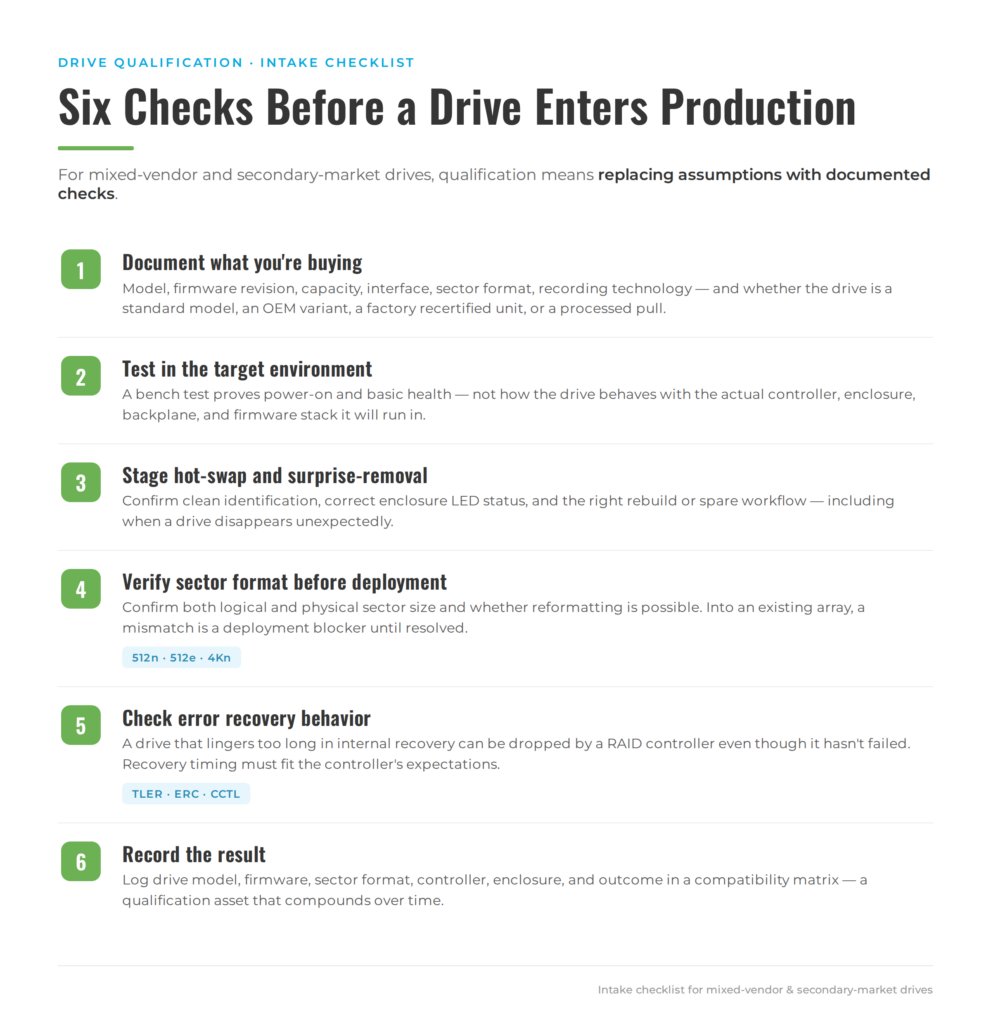
For systems integrators working with mixed-vendor or secondary-market drives, the qualification process should cover a few basics:
- Document exactly what is being purchased. At minimum, record the model number, firmware revision, capacity, interface, sector format, and recording technology. Note whether the drive is a standard manufacturer model, an OEM-customized variant, a factory recertified unit, or a processed pull.
- Test in the target environment whenever possible. A generic bench test can confirm that a drive powers on, reports basic health information, and can read/write data. It cannot fully confirm how the drive will behave with the actual controller, enclosure, backplane, or firmware stack in production.
- Stage hot-swap and surprise-removal tests. Confirm that the drive identifies cleanly and reports expected status. Check that it triggers the correct enclosure indicators, and moves into the appropriate rebuild, spare, or provisioning workflow. A system that handles clean replacement but becomes unstable when a drive disappears unexpectedly has not been fully qualified.
- Verify sector format before deployment. Confirm both logical and physical sector size, determine whether reformatting is possible, and avoid assuming that model number, capacity, or interface tells the full story. If the drive is entering an existing array, sector-format mismatch should be treated as a deployment blocker until resolved.
- Check error recovery behavior. A drive too long in internal recovery can be ejected by a RAID controller even if it hasn’t actually failed. Qualification should confirm that recovery behavior fits the controller’s expectations. This is especially true for arrays that will see rebuild pressure or sustained workload stress.
- Record the result. Even a simple internal compatibility matrix can reduce repeated trial and error. A useful matrix might track drive model, firmware revision, and sector format. Also track controller, enclosure, operating system or storage platform, test result, and deployment notes.
Qualification Should Continue After Intake
The same principle shows up at scale. Backblaze’s 2025 Drive Stats report describes a process of testing drives before they enter the fleet, then monitoring and replacing them based on risk factors before they fail. The firm’s operating environment is much larger than most integrators’, but the underlying discipline is relevant: qualification does not end when a drive is detected. It continues through testing, monitoring, and lifecycle decisions.
Source quality matters, too. A distributor that can provide known provenance, consistent testing, clear documentation, and experience with mixed-vendor storage environments can reduce the qualification burden on the buyer. It does not eliminate the need to test drives in the target system, but it does reduce the number of unknowns the integrator has to resolve alone.
Why This Matters
Mixed-vendor qualification has always mattered, but current market conditions have made it more urgent. AI-driven demand has tightened parts of the storage supply chain and pushed more buyers to consider inventory outside their usual procurement paths. For systems integrators, that often means evaluating a broader mix of drive sources, drive histories, and vendor combinations.
That shift does not make secondary-market sourcing less viable. In many cases, it makes secondary-market expertise more valuable. But it does change the questions buyers need to ask. Availability and price are only part of the procurement decision. The more important question is whether the drive can be identified, documented, tested, and qualified for the system where it will be used.
Factory recertified drives can reduce part of that uncertainty. They do not eliminate the need to qualify a drive for the target controller, enclosure, and workload, but they can provide a clearer validation path than ordinary processed pulls. Recertified inventory comes through manufacturer-backed channels, while processed pulls place more of the qualification burden on the buyer, integrator, or distributor.
From Available Inventory to Usable Stock
“We’re seeing more customers become receptive to factory recertified drives because the supply picture has changed,” Buckler says. “AI is the primary catalyst, but the bigger point is that buyers still need reliable capacity. Recertified drives can help bridge that gap. The value is not just that the drive is available. It is knowing what it is, how it was tested, and where it can be used with confidence.”
For mixed-vendor storage buyers, the practical takeaway is straightforward: do not stop at “does it fit?” or “does the system see it?” A drive should be evaluated by model, firmware, sector format, recording technology, controller behavior, error recovery timing, and actual performance in the target environment.
In a tighter storage market, confidence becomes part of the product. Buyers need confidence that the drive has been identified correctly, tested under the right conditions, and qualified for the system it is entering. That is where a disciplined qualification process — and a sourcing partner that understands mixed-vendor storage — can make the difference between available inventory and usable capacity.