




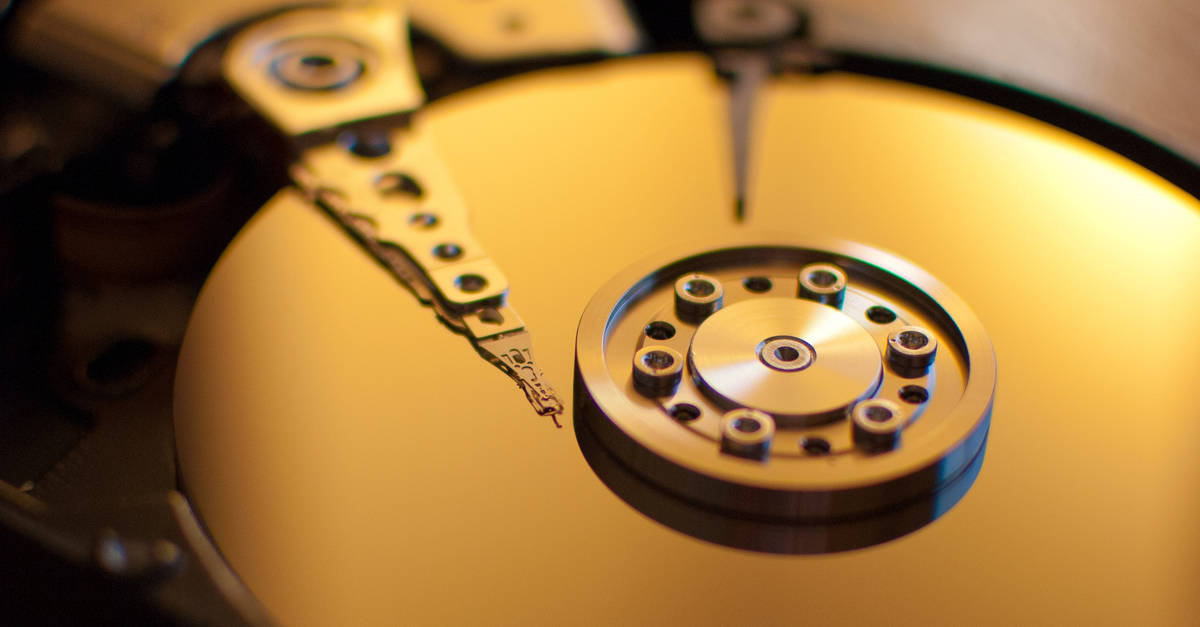
Hard drives remain central to data center storage for a stubbornly practical reason: enormous volumes of data still need to be stored economically at scale. Flash keeps advancing where performance, latency, and power justify the premium, but HDDs continue to anchor the capacity layer of modern storage infrastructure.
Flash has spent years getting faster, denser, and cheaper. Yet the basic problem facing large data centers has barely changed: how do you store enormous and continually growing volumes of data without allowing capacity costs to overwhelm the infrastructure around them?
For much of that data, the answer is still the hard disk drive.
Recent materials from Backblaze and Western Digital, both citing IDC’s Worldwide Global StorageSphere Forecast, 2025–2029, place HDD at around 80% of cloud storage. That does not mean HDD leads every storage metric—flash captures performance-sensitive workloads and substantial market value—but it demonstrates the continuing scale of disk within the capacity layer. For capacity-oriented workloads, the economics of every additional terabyte still matter as much as raw speed.
- Storage at Scale Is an Economics Problem
- HDD and Flash Solve Different Storage Problems
- When Does Flash Replace HDD?
- AI Is Transforming the Storage Hierarchy
- AI Needs Both Speed and Capacity
- Higher-Capacity HDDs Keep Moving the Economics
- How Should Data Centers Decide Where HDD Fits?
- The Future of Data Center Storage Is Tiered
Storage at Scale Is an Economics Problem
For a contrast to the current storage landscape, let’s look back a few years. These were trying times for HDD manufacturers.
For capacity-oriented workloads, HDD retains a major acquisition-cost advantage. Current 2026 research from TrendForce puts enterprise QLC SSD at roughly 15× the per-gigabyte price of HDD. A separate August pricing index from hybrid-storage vendor VDURA, reported by StorageReview, landed at almost the same ratio: $18,080 for a 30TB QLC SSD versus $1,216 for a 30TB HDD, or about 14.9×. The exact gap varies by product, capacity, and market conditions. At petabyte or exabyte scale, that premium can translate into a very different capital requirement.
Cost per terabyte is where the storage conversation starts, but it is not where the bill ends. Purchase price alone does not determine the right storage tier. A broader SSD vs. HDD TCO calculation also has to account for power, density, workload characteristics, and other lifecycle variables. At scale, IT teams pay to power, cool, and manage a growing body of data.
HDD and Flash Solve Different Storage Problems
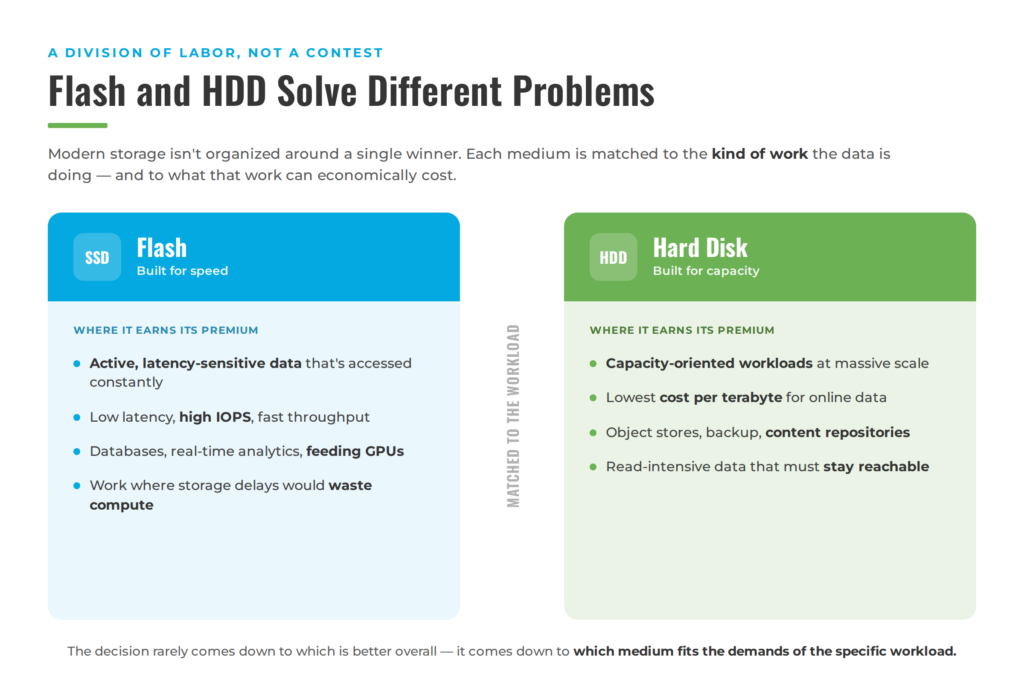
In practice, large storage environments already work this way: not around a single winner, but around a division of labor.
Flash earns its premium where access speed has direct value. Low latency, high IOPS, and fast throughput make SSDs well suited to active databases, metadata-intensive applications, caching, high-performance analytics, and AI workloads where storage delays can leave expensive compute resources underutilized.
HDD earns its place where capacity matters more than flash-level response time. Large object stores, backup and recovery environments, content repositories, warm and cooler data tiers, and other capacity-oriented workloads can all fit that profile.
That division of labor is visible in production systems. Meta’s current AI storage architecture uses memory and flash progressively closer to compute while retaining an HDD-backed global storage fabric beneath those faster tiers. The architecture is built around matching storage performance to workload requirements rather than replacing one medium wholesale with another.
Google describes a similar distinction in Spanner’s tiered-storage guidance, identifying SSD for active data requiring high throughput and low latency while positioning HDD for larger datasets that are less latency-sensitive, less frequently accessed, or particularly cost-sensitive.
Microsoft likewise recommends hybrid storage configurations where environments need both substantial capacity and high performance, using faster media as a cache in front of larger HDD tiers.
Workload Placement Matters
These examples point to a broader principle: the value of a storage medium depends on where it sits in the workload path. A terabyte serving latency-sensitive transactions is not economically equivalent to a terabyte holding historical training data, backups, media assets, or a large object archive.
The HDD-versus-flash question therefore becomes a placement decision: which data requires the performance premium of flash, and which can be stored more economically on HDD without compromising the workload? That same model underpins hybrid storage architecture for AI, where different media serve different stages of the data path.
When Does Flash Replace HDD?
The economics begin to change when capacity is no longer enough. A workload may require lower latency, higher IOPS, or faster access to small files and metadata than HDD can efficiently provide. Greater HDD capacity can introduce a trade-off of its own: Meta has noted that HDD capacity has increased much faster than I/O performance, reducing bandwidth per terabyte as drives become denser. For sufficiently read-intensive workloads, that can leave usable capacity stranded by performance constraints.
Meta is introducing QLC SSD as a middle tier between HDD and higher-performance TLC flash, while noting that QLC is not yet price-competitive enough for broad deployment. It is a clear example of workload demands moving the boundary between media.
Power, Density, and Availability Shift the Equation
The next pressure point is the facility itself. Where rack space, power, or cooling are scarce, flash may consolidate capacity and performance into substantially fewer devices. At the extreme end, Micron’s 245TB QLC data center SSD illustrates how far flash density has progressed.
Power pressure is becoming especially important around AI infrastructure. The IEA reports that AI-server power density increased elevenfold between 2020 and 2025 and could rise another fourfold by 2027. In those environments, storage efficiency can affect how much facility capacity remains available for compute.
Availability can move the boundary too. TrendForce has reported that nearline HDD constraints pushed some cloud providers to evaluate QLC SSDs for workloads that might traditionally have remained on disk, including some colder data.
None of this adds up to a clean takeover of the capacity tier. The decision still comes down to whether the performance, density, or efficiency being purchased is worth the capacity premium.
AI Is Transforming the Storage Hierarchy
AI puts the fastest layers of the storage stack under unusual pressure. Checkpoints and frequently accessed datasets may need to move quickly enough to keep GPUs and other accelerators supplied with data. Flash earns its place in those environments because storage latency can translate directly into underused compute.
The twist is that AI also creates and preserves large volumes of data that do not need to remain on the highest-performance tier. Raw training corpora, older dataset versions, historical checkpoints, generated outputs, telemetry, and archived features can accumulate rapidly as models and pipelines evolve.
Recent research suggests that the retention window is widening as well. A September 2026 IDC study sponsored by Western Digital found that organizations were retaining AI-related data for longer and bringing more previously cold data back online for new workloads.
AI Needs Both Speed and Capacity
The deeper AI data retention question includes why historical datasets and other artifacts can retain value long after their first use. From a storage perspective, the consequence is a two-sided problem: active parts of the AI workflow need extremely fast access close to compute, while the much larger persistent data estate still needs an economical place to live.
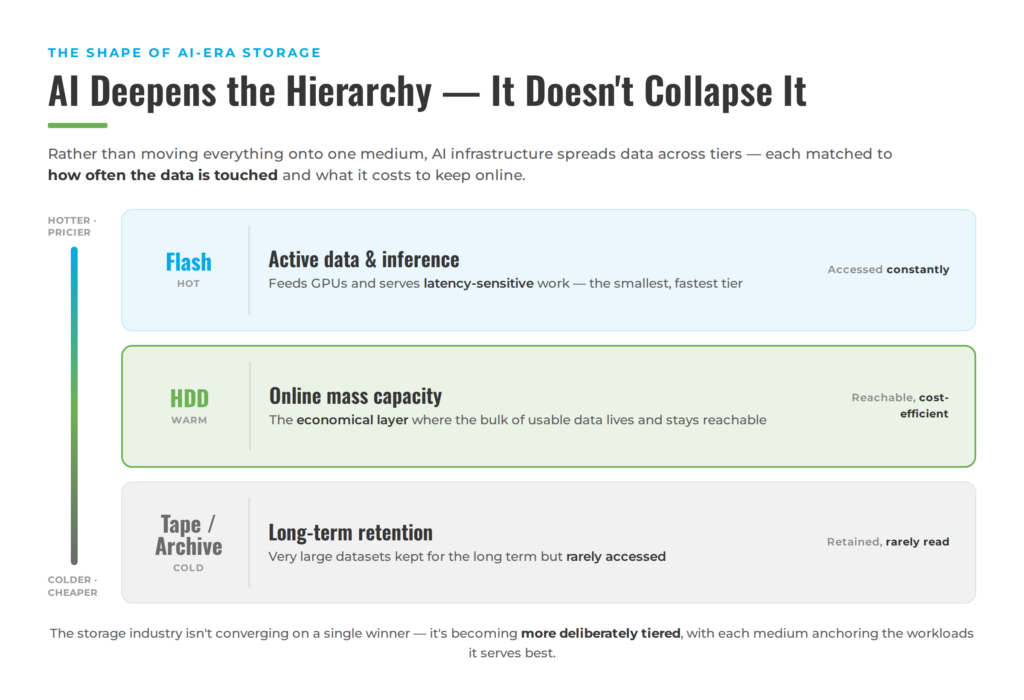
Tiered architectures allow those requirements to coexist: frequently accessed or latency-sensitive data can remain on flash, while larger persistent datasets move to capacity-oriented storage until needed again.
Higher-Capacity HDDs Keep Moving the Economics
HDD is not standing still. Manufacturers continue to increase the number of terabytes delivered through the same basic 3.5-inch enterprise drive footprint, changing the economics of the capacity tier as they do.
The market is increasingly telling that story in terabytes rather than drive counts. TRENDFOCUS data cited by SNIA shows nearline HDD capacity shipments growing much faster than drive unit volumes—evidence that capacity is expanding much faster than physical drive counts.
The roadmaps show how manufacturers are supplying that demand. Seagate’s Mozaic 4+ platform, which is in production with hyperscale cloud customers, supports capacities up to 44TB. Western Digital’s current roadmap has its 40TB UltraSMR ePMR drive in qualification with hyperscalers while mapping HAMR toward 100TB later in the decade. Toshiba’s M12 nearline platform is sampling SMR drives ranging from 30TB to 34TB.
More Capacity Changes the Infrastructure Math
Areal density is central to that progress. Technologies such as HAMR increase the amount of data that can be stored on each platter, while advances in media, heads, firmware, and recording architectures continue pushing usable capacity higher.
For data centers, the payoff is not the recording technology itself but what added capacity does to the system around the drive. Greater capacity per device means operators can either support the same dataset with fewer drives and less surrounding infrastructure, or expand capacity substantially without growing the physical estate at the same rate.
That does not mean every environment should refresh as soon as a denser drive appears. Qualification, rebuild behavior, failure domains, migration costs, compatibility, and the value of existing hardware still matter.
How Should Data Centers Decide Where HDD Fits?
The right storage medium depends less on what is newest than on what the workload actually requires.
What Does the Workload Need, and How Is the Data Accessed?
Begin with the application rather than the device. Does the workload depend on very low latency, high IOPS, or consistently high throughput? Is the data accessed continuously, intermittently, or only when a particular process requires it?
Capacity-oriented workloads can often tolerate higher latency and lower IOPS. That does not make the data less important; it means paying for the highest available performance may create little additional value.
How Much Data Is There, and How Long Must It Remain Available?
Scale changes the economics. A storage premium that looks manageable at tens of terabytes can become substantial at petabyte or exabyte scale.
Retention matters for the same reason. Data may need to remain accessible for compliance, backup, analytics, model development, historical comparison, or future uses that were not known when it was created. AI has drastically accelerated the movement toward larger and longer-lived data estates.
What Are the Real Facility Constraints?
In a power-constrained AI environment, reducing storage energy consumption may create more headroom for compute. Elsewhere, rack capacity, floor space, or the number of devices an operations team can practically support may matter more.
What Will the Storage Cost Over Its Useful Life?
Lifecycle cost also includes power, cooling, maintenance, supporting infrastructure, qualification, migration, and replacement. The question is whether the performance or efficiency gained from a storage choice justifies that total cost.
Taken together, these questions lead back to a simple principle: Choose the storage medium that best fits the workload rather than beginning with a preferred technology.
The Future of Data Center Storage Is Tiered
The storage industry is not converging on a single winner. It is becoming more deliberately tiered. Flash is indispensable where latency, throughput, and compute efficiency justify its premium; HDD continues to dominate environments where the challenge is retaining enormous amounts of data economically.
As data estates expand—and AI increases demand at both ends of the performance spectrum—the division of labor becomes more important. Performance and capacity are being placed according to workload rather than treated as a single technology choice.
The more useful question is not whether HDD or flash will win, but where each belongs and what the workload requires from it.
Whether you’re buying or disposing of data storage capacity, learn more about how Horizon Technology leverages its deep industry expertise to support your enterprise hard drive needs.