




AI storage is not one workload. Flash owns the performance-sensitive hot path, while high-capacity HDDs remain important across the much larger data estate that surrounds it.
AI infrastructure is usually described in terms of GPUs, high-bandwidth memory, networking and flash. Those are the components that dominate the hot path, where every delay can affect training time, GPU utilization or real-time service behavior.
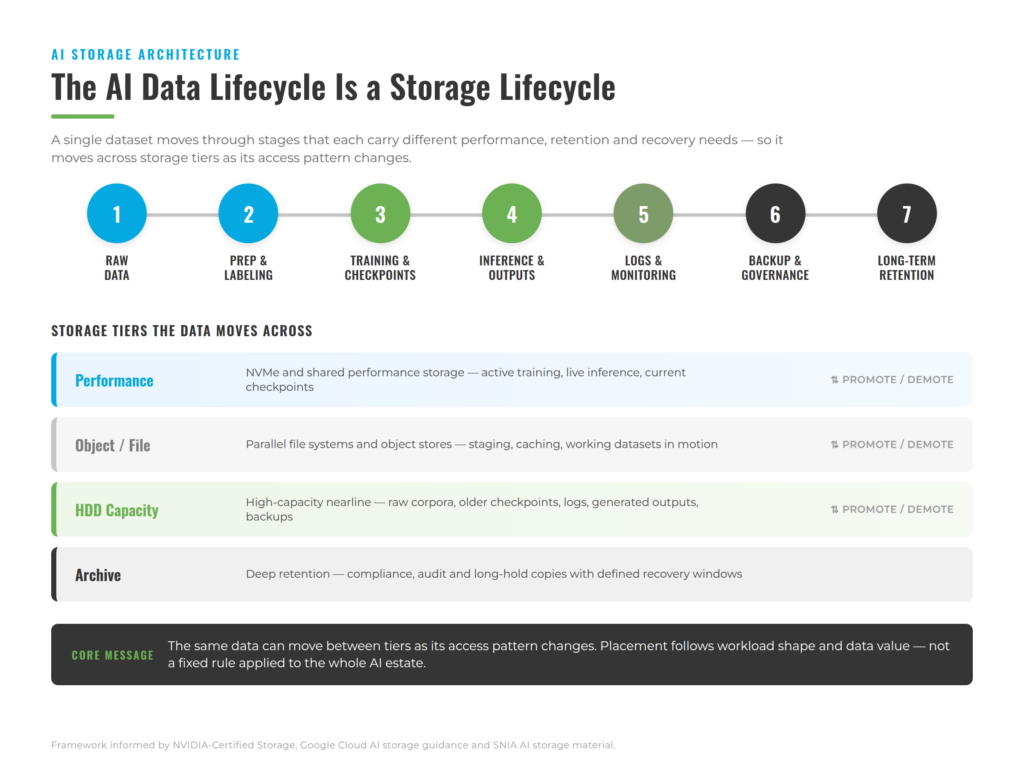
But an AI model sits inside a much larger data lifecycle. Raw corpora have to be collected and preserved. Datasets are cleaned, labeled, versioned and copied. Training creates checkpoints and evaluation artifacts, while production systems generate logs, telemetry and backups.
The instinct to put everything on the fastest tier collides quickly with the arithmetic of that data estate. HDDs are not a shortcut to faster inference, and they are not a substitute for flash where latency, IOPS or throughput determine application performance. Their role is different: affordable, durable capacity for data whose value lies in its scale, retention period, recoverability or future reuse.
AI Storage Is Not One Workload
A common planning mistake is to treat “AI data” as though it has one access pattern. In practice, an AI program spans source and training data, model artifacts, operational data, generated outputs, and long-term copies retained for recovery, compliance, or future reuse.
Each class carries a different combination of performance requirement, access frequency, retention value and recovery objective. Some data is reread continuously and has to feed accelerators at very high throughput, whereas others are written once and retained for months or years. Even the same dataset can change character over time as it moves from active development into retention, audit or reuse.
Current industry guidance reflects that diversity. NVIDIA-Certified Storage evaluates training, fine-tuning, inference and key-value cache workloads separately because their I/O patterns differ. Google Cloud’s AI storage guidance likewise distinguishes scalable object capacity from low-latency parallel file storage and recommends different services according to throughput, latency, and checkpointing needs. SNIA’s vendor-neutral AI storage material makes the same broader point: storage requirements change across preparation, training, checkpointing and inference.
Storage placement should therefore begin with workload shape, not with a preferred medium.
- How much data is active?
- How often is it reread?
- Does it feed GPUs directly?
- How fast must it be recovered?
- How long will it be retained, and what is the business or governance value of keeping it?
Those questions produce a more defensible architecture than applying one rule to the entire AI estate.
What Usually Belongs on Flash
Flash earns its place wherever storage performance directly affects expensive compute. Active training data, preprocessing pipelines, live inference systems and current checkpoints may all require high throughput, low latency or fast recovery.
NVIDIA’s DGX SuperPOD guidance, for example, notes that models may read training data repeatedly and that large checkpoints can interrupt progress during writes. In these parts of the workflow, local NVMe, high-performance shared storage and caching help keep GPUs productive.
The key distinction is not that all active AI data must remain on flash indefinitely. It is that the performance tier must be fast enough for the current working set, with a clear path for staging data in and moving it out once that premium performance is no longer required.
What Typically Belongs on High-Capacity HDDs
High-capacity HDDs are strongest where the dominant requirement is durable capacity at scale. In enterprise and hyperscale environments, that usually means nearline drives: high-capacity, always-available HDDs designed for large storage pools rather than low-latency transactional workloads.
The data stored there is not necessarily forgotten or inactive. It may remain valuable, searchable and periodically reactivated; it simply does not need flash-level latency or IOPS for the entire time it is retained. Raw datasets, older checkpoints, generated outputs, logs, backups and governance records can all become candidates once their immediate performance requirements fall away.
Current roadmaps from WD, Seagate and Toshiba increasingly position high-capacity HDDs within this broader AI storage hierarchy. That does not make HDD the right destination for every dataset, but it does reinforce their role as the capacity layer for large, durable and retained data.
Where Simple Hot-and-Cold Rules Break Down
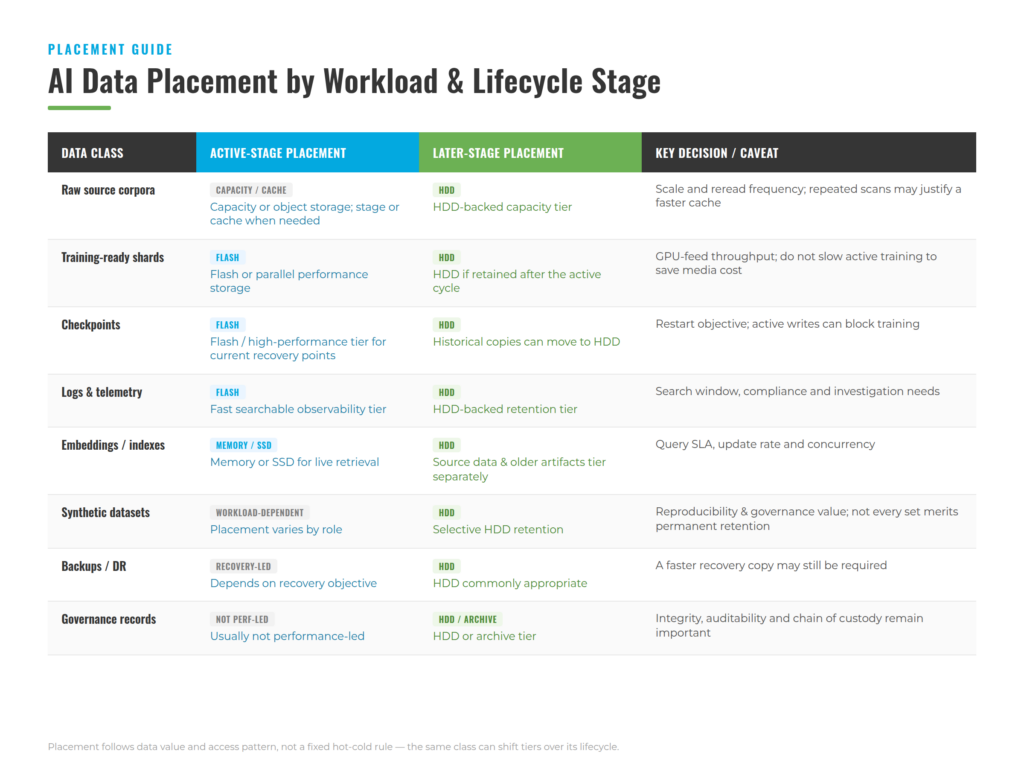
“Hot on flash, cold on disk” is directionally useful, but it is too crude for serious planning. Several important AI data classes change their storage requirements over time or contain both performance-sensitive and retention-oriented components.
1. Checkpoints move from operationally critical to historically useful
During active training, checkpoints can be among the most demanding storage operations in the pipeline. ByteCheckpoint, MLCommons and AWS all treat checkpointing as a distinct performance challenge because large model states must be saved, loaded and sometimes resharded without creating long stalls.
That supports flash, memory or another high-performance tier while a checkpoint remains part of the immediate recovery path. But once the rapid-restart window closes, selected checkpoints retained for audit, rollback, evaluation or lineage can move to lower-cost capacity storage.
2. Logs and telemetry have a hot window and a long tail
Operational logs need rapid indexing and search while teams are diagnosing performance, security or reliability issues. Over time, the question changes. Instead of “how quickly can we search this?” it becomes “how long must we keep it, at what cost, and how quickly might we need to restore it?”
That shift can support a tiered observability model in which recent data remains on a fast searchable tier while older records move into lower-cost storage under explicit retention and retrieval policies. Some environments will keep particular logs hot for longer; the point is to define the window rather than assume one permanent placement.
3. Live vector retrieval is not an HDD workload
Embeddings and vector indexes do not all have the same storage needs. Live retrieval systems with tight latency targets, frequent updates, and high concurrency generally belong in memory, flash, or another performance tier.
The surrounding data can tier differently. Source datasets, older indexes, evaluation runs, and historical embedding versions may suit lower-cost capacity storage. The key is to separate the live serving path from the broader data estate.
4. Synthetic data expands the estate, but retention should be selective
Synthetic data can multiply the number of datasets created during development and testing, but not every version merits long-term retention. Some support training, evaluation, reproducibility, or governance; others are temporary, low quality, or quickly superseded.
Teams may need to preserve generation methods, seed data, prompts, parameters, and selected outputs without keeping every intermediate artifact indefinitely. The goal is a defensible development record, not permanent storage for everything generated.
AI Data Growth Is Turning Capacity Planning into a Sourcing Discipline
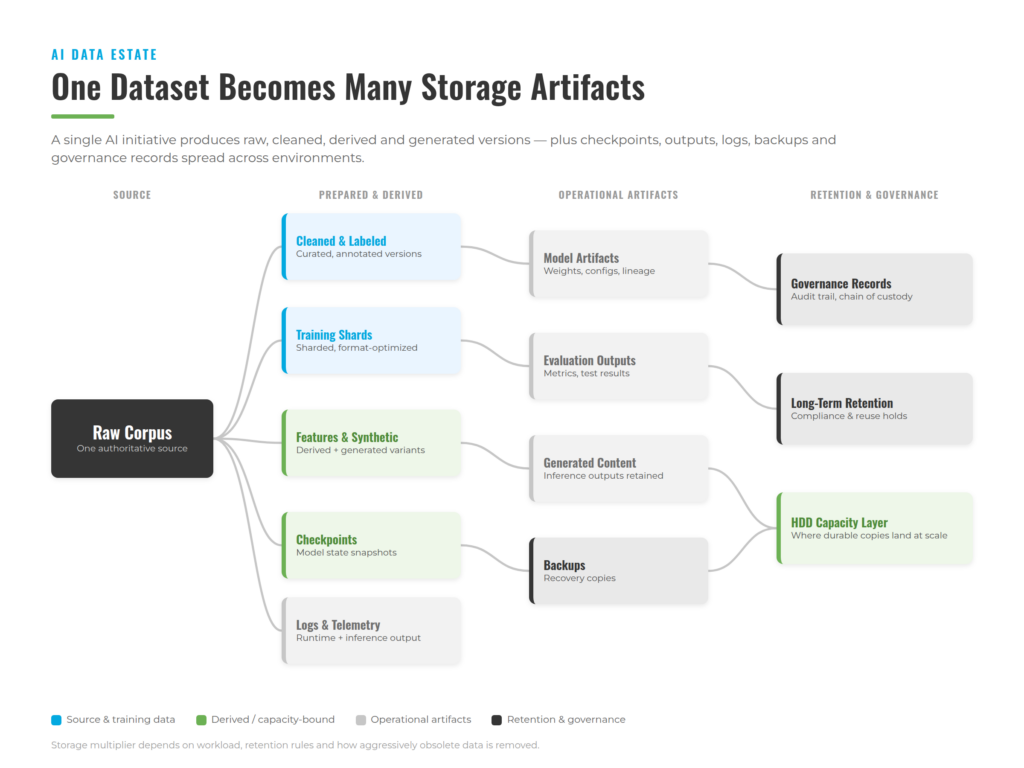
AI teams rarely store one authoritative copy of a dataset. A single initiative can generate raw, cleaned, labeled, training-ready, synthetic, and derived versions, along with checkpoints, logs, outputs, governance records, and backups spread across multiple environments.
There is no universal multiplier for how much storage this creates; it depends on the workload, retention rules, and how aggressively obsolete data is removed. The structural point remains: AI produces derivatives and history, not just one active training set.
Storage analyst Tom Coughlin estimates that AI buildout added roughly 363 exabytes of HDD demand in 2026—about 18% of expected capacity shipments. His model raises that share to 43% in 2028 and 58% in 2030.
AI demand is colliding with a constrained supply market
Demand is arriving in a constrained supply environment. TrendForce reported in September 2025 that nearline HDD lead times had stretched beyond 52 weeks, while IDC’s 2026–2030 forecast describes rising hyperscale demand alongside only modest investment in additional exabyte supply capability. These are market snapshots, but they show why planning architecture and procurement separately is not a wise strategy.
At the same time, capacity roadmaps are accelerating. WD has a 40TB UltraSMR drive in hyperscale qualification and targets 60TB ePMR and 100TB HAMR by 2029. Seagate’s Mozaic 4+ is shipping at up to 44TB to two hyperscale providers, while Toshiba began sampling 30–34TB M12 drives in March 2026. Horizon’s review of the race to 100TB examines these roadmaps in more detail.
For buyers and systems integrators, the implication is clear: AI storage planning must account for lead times, qualification windows, model and firmware availability, and the sourcing strategy required to deploy usable capacity on schedule.
Tiering Is the Architecture Question
The future of AI storage is not a clean victory for one medium. It is the controlled placement and movement of data across tiers.
A defensible placement framework weighs:
- access frequency and reread pattern;
- latency, IOPS and throughput sensitivity;
- file size, metadata intensity and read/write mix;
- durability and recovery objectives;
- retention, governance and audit value;
- cost per terabyte, power and rack constraints;
- operational complexity and data-movement overhead; and
- the availability of qualified capacity on the required timeline.
Under that framework, flash owns the hot, performance-sensitive layers. HDDs remain strong where scale, retention and economics dominate. In between, the architecture uses caching, staging, parallel file systems, object stores, lifecycle policies and data movers to promote and demote data as its role changes.
Procurement and Lifecycle Considerations for AI-Era HDD Capacity
Once HDD-backed capacity enters the plan, cost per terabyte is only part of the decision. A drive may fit the system yet carry incompatible firmware, sector formatting, error-recovery behavior, or qualification history. Controller, enclosure, interface, and workload requirements determine whether available capacity is actually deployable.
That makes firmware access, mixed-vendor qualification, and a market increasingly shaped by HDD long-term agreements part of the architecture discussion. Buyers should document the exact model and firmware, verify format and recording technology, and test the drive in its intended controller and enclosure.
Factory-recertified capacity is a lever, not a shortcut
In a tight market, factory-recertified drives may bridge supply gaps or extend an existing qualified platform. But they are not universally interchangeable: provenance, testing, warranty, firmware, and workload fit still matter. The distinction between factory-recertified and conventionally refurbished drives is therefore central to the decision.
The rule is straightforward: recertified capacity can strengthen a sourcing strategy, but it does not replace engineering review. A tiering plan has little value if the required drives arrive late, fail qualification, or behave unpredictably in production.
“The challenge is not simply finding capacity somewhere in the market,” remarks Horizon chief operating officer Stephen Buckler. “It is securing the right model, firmware and qualification history within the window the project requires. Factory-recertified drives can be an effective way to extend a proven platform or bridge a supply gap, but they still need the same discipline around traceability, testing and workload fit as new inventory.”
Match Data Value and Access Pattern to the Right Tier
AI storage planning begins with the lifecycle of the data, not the label on the drive. Flash remains essential for active, latency-sensitive and throughput-intensive stages. High-capacity HDDs remain important where AI creates a capacity, retention, backup, archive or lifecycle-management problem rather than a low-latency serving problem.
Between those poles, caching, staging and policy-driven data movement allow the same information to occupy different tiers at different moments. That is where high-capacity HDDs fit in the AI era: not as an inference accelerator, and not as a universal answer, but as the capacity layer that can keep the broader AI data estate economically sustainable.